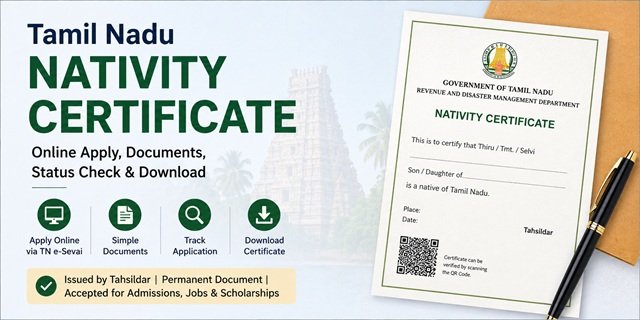
In Tamil Nadu, the document commonly used as a domicile certificate is officially called the Nativity Certificate (தாய்நாட்டு சான்றிதழ்). It is issued by the Revenue and Disaster Management Department through the Tahsildar after local verification. Citizens can apply online through the official TN e-Sevai Portal, which is managed by the Tamil Nadu e-Governance Agency (TNeGA), or through authorised e-Sevai Centres across the state.
The Nativity Certificate is commonly required for Tamil Nadu state quota admissions in professional courses, Tamil Nadu Engineering Admissions (TNEA), certain TNPSC recruitments, state government scholarships, and other schemes or benefits where proof of Tamil Nadu nativity is required.
Before applying, understand one important distinction. In Tamil Nadu, the Nativity Certificate and Residence Certificate are two different services on the TN e-Sevai portal.
The Nativity Certificate (REV-102) establishes your connection to Tamil Nadu as your native state and is commonly required for Tamil Nadu state quota admissions, TNPSC recruitments, scholarships, and other benefits where proof of Tamil Nadu nativity is required.
The Residence Certificate (REV-116) only confirms that you currently live at a particular address in Tamil Nadu. It serves as an address or residence proof but does not establish Tamil Nadu nativity. If an admission authority, recruitment notification, or scholarship guideline specifically asks for a Nativity Certificate, submitting a Residence Certificate may not be accepted.
Therefore, applicants should carefully select the correct service while applying through the TN e-Sevai portal. For domicile or native-state proof, apply for the Nativity Certificate (REV-102), not the Residence Certificate (REV-116).
Who Is Eligible for a Tamil Nadu Nativity Certificate?
You may be eligible for a Nativity Certificate if any of the following situations apply:
- You were born in Tamil Nadu and can produce supporting records showing Tamil Nadu as your place of birth.
- Your parents are natives or permanent residents of Tamil Nadu, even if you are currently residing outside the state.
- You have been ordinarily residing in Tamil Nadu for a substantial period and can provide acceptable residence-related records during verification.
The final decision is taken by the competent Revenue Authority after verification of the documents and local records submitted with the application.
NEET Tamil Nadu State Quota: Why Nativity Documents Matter
Students applying for Tamil Nadu state quota medical admissions should pay special attention to nativity-related documents. The exact eligibility conditions and document requirements are announced every year through the official counselling notification, so applicants should always verify the latest prospectus before submitting documents.
Students who completed their schooling in Tamil Nadu: School records such as Transfer Certificates (TCs), study certificates, and marksheets issued by Tamil Nadu schools are often important supporting documents during the admission process. Keep records from multiple academic years ready if requested during counselling.
Students claiming nativity through birth in Tamil Nadu: A valid Birth Certificate showing Tamil Nadu as the place of birth may be required along with other supporting records.
Students claiming nativity through parents: Parent-related documents such as voter records, residence records, ration card entries, or other government-issued documents showing the family’s connection to Tamil Nadu may be required during verification.
The Nativity Certificate remains an important supporting document, but applicants should carefully follow the document checklist published in the relevant counselling notification for that year.
Documents Required for Tamil Nadu Nativity Certificate
- Aadhaar Card – identity proof of the applicant
- Ration Card – useful proof of family residence in Tamil Nadu
- Voter ID Card – residence-related proof for the applicant or parents, wherever applicable
- Birth Certificate – especially important when claiming nativity based on birth in Tamil Nadu
- School Transfer Certificate (TC), Study Certificate, or School Records – useful evidence of long-term study in Tamil Nadu
- Parents’ residence-related documents – such as voter records, ration card, residence records, or other government-issued documents showing Tamil Nadu connection
- Self-declaration or affidavit – if required by the competent authority during verification
- Passport-size photograph
The Tahsildar may request additional documents depending on the basis of your nativity claim, such as birth in Tamil Nadu, parental nativity, or long-term residence within the state.
How to Apply Online for a Tamil Nadu Nativity Certificate
Tamil Nadu citizens can apply for a Nativity Certificate through the official TN e-Sevai Portal. The online system is managed by the Tamil Nadu e-Governance Agency (TNeGA) and allows applicants to submit applications without visiting the Taluk Office initially.
Step 1: Visit the official TN e-Sevai Portal. If you are a new user, click Citizen Registration and create an account using your mobile number and email address. Complete OTP verification and create your login credentials.
Step 2: Log in to your account and open the list of Revenue Department services.
Step 3: Search for Nativity Certificate (REV-102) and select the service.
Step 4: Fill in the application form carefully. Enter your personal details, current address, district, taluk, village, and the basis on which you are claiming Tamil Nadu nativity, such as birth in Tamil Nadu, parents’ nativity, or long-term residence.
Step 5: Upload all supporting documents. Depending on your case, these may include your Aadhaar Card, Ration Card, Voter ID Card, school records, or Birth Certificate.
Step 6: Review the application carefully and submit it. After successful submission, the portal generates an Application Reference Number. Save this number because it is required for status tracking and certificate download.
Step 7: If applicable, pay the prescribed service charge through the online payment gateway and keep the payment receipt for future reference.
How to Apply Through the TNeGA Citizen Services Portal
Tamil Nadu citizens can also access government certificate services through the official Tamil Nadu e-Governance Agency (TNeGA) portal at tnega.tn.gov.in. The portal acts as a gateway to various Tamil Nadu Government citizen services, including services delivered through the TN e-Sevai system.
Step 1: Visit tnega.tn.gov.in and open the Citizen Services section.
Step 2: Select the option to access online government services.
Step 3: Choose Revenue Department services and proceed to the Nativity Certificate service.
Step 4: Complete the required authentication or login process and fill in the application details.
Step 5: Upload the required supporting documents and submit the application.
Step 6: Save the Application Reference Number generated by the system for future tracking and certificate download.
In practice, the application is processed through the Tamil Nadu e-Sevai ecosystem managed by TNeGA. Applicants may therefore encounter TN e-Sevai interfaces during the submission process.
How to Apply Through a Tamil Nadu e-Sevai Centre
If you are not comfortable using the online portal, you can visit an authorised e-Sevai Centre operating under TNeGA. These centres are available throughout Tamil Nadu and assist citizens with online government services.
Step 1: Visit the nearest e-Sevai Centre with all original documents and photocopies.
Step 2: Inform the operator that you want to apply for a Nativity Certificate (REV-102).
Step 3: The operator enters your details into the TN e-Sevai system and uploads the required documents.
Step 4: Verify all information before submission and collect the acknowledgement receipt containing your Application Reference Number.
Step 5: Keep the acknowledgement safely until the certificate is issued.
How to Apply Through the VAO or Taluk Office
In certain situations, applicants may be asked to submit supporting records through the local revenue administration. The verification process usually begins at the village level and moves through the Revenue Department hierarchy.
Step 1: Contact your local Village Administrative Officer (VAO) or visit the Taluk Office serving your area.
Step 2: Submit the required documents supporting your nativity claim.
Step 3: The VAO examines local records and verifies the information provided in the application.
Step 4: The application may then be reviewed by the Revenue Inspector for further verification.
Step 5: After successful verification, the file reaches the Tahsildar, who is the competent authority responsible for approving and issuing the Nativity Certificate.
What Happens After You Apply: The Verification Process
After you submit your Nativity Certificate application, it enters the Revenue Department’s verification process. The purpose of this verification is to confirm your connection with Tamil Nadu based on the documents and information provided in the application.
Step 1: Village Administrative Officer (VAO) Verification
The application is first forwarded to the local Village Administrative Officer (VAO) or the appropriate field-level revenue authority. The officer examines the documents submitted with the application and verifies local residence or nativity-related records wherever required.
Step 2: Revenue Inspector Review
In many cases, the application is further reviewed by the Revenue Inspector (RI) before being forwarded to the Tahsildar. Additional clarification or supporting documents may be requested if required.
Step 3: Tahsildar Approval
After successful verification, the application reaches the Tahsildar, who is the competent authority for issuing the Nativity Certificate. Once satisfied with the verification report and supporting documents, the Tahsildar approves the application and issues the certificate electronically.
If any discrepancy is found during verification, the Revenue Department may place the application on hold and request additional documents. Responding quickly to such queries can help avoid delays.
How to Track Your Application Status
Applicants can track their application using the Application Reference Number generated during submission.
Option 1: Log in to the official TN e-Sevai Portal and check the status from your dashboard.
Option 2: Use the Tamil Nadu e-District status tracking facility and enter your Application Reference Number to view the latest processing stage.
The status generally shows whether the application is under verification, pending clarification, approved, or completed.
How to Download Your Tamil Nadu Nativity Certificate
After approval, log in to the portal through which you submitted the application and open your certificate dashboard.
Select the approved Nativity Certificate application and download the digitally signed PDF copy. Keep both a digital copy and a printed copy for admissions, recruitment processes, scholarships, and other official purposes.
Applicants who submitted the application through an e-Sevai Centre can also seek assistance from the same centre for downloading the approved certificate.
Processing Time and Fee
- Processing Time: Usually around 15 to 30 days, depending on document verification and district workload.
- Service Charges: Online and e-Sevai service charges may vary from time to time as notified by the Government of Tamil Nadu.
- Additional Verification Time: Applications requiring further field verification may take longer.
Validity of Tamil Nadu Nativity Certificate
The Tamil Nadu Nativity Certificate is generally treated as a long-term proof of nativity within the State. Once issued by the competent Revenue Authority, it can be used for admissions, recruitment processes, scholarships, and other purposes where Tamil Nadu nativity is required.
However, some admission authorities, recruitment boards, or educational institutions may specifically ask for a recently issued certificate. Therefore, applicants should always check the latest eligibility conditions mentioned in the concerned notification before submitting their documents.
Common Problems and Their Solutions
Application remains under verification for a long time: If your application shows no movement for an extended period, contact your Village Administrative Officer (VAO), Taluk Office, or the Tamil Nadu e-Sevai Helpdesk. Keep your Application Reference Number ready while making enquiries.
Address or personal details do not match across documents: Ensure that your name, father’s name, date of birth, and address are consistent across your Aadhaar Card, voter ID, ration card, school records, and other supporting documents. Mismatches often lead to verification queries.
Unable to upload documents: Check the permitted file format and size limits mentioned on the portal. Scan documents clearly and ensure all information is visible before uploading.
Application rejected due to insufficient proof: Review the reason mentioned in the rejection remarks. Submit additional residence, birth, educational, or parental residence documents as applicable and apply again with a stronger set of supporting records.
Need correction in an issued certificate: Visit the concerned Taluk Office or Revenue Authority that issued the certificate and submit a correction request along with documentary proof supporting the required changes.
Tamil Nadu Nativity Certificate for Special Cases
Students applying under Tamil Nadu State Quota admissions: Keep all educational records, transfer certificates, nativity-related documents, and any additional documents specified in the admission notification ready before counselling begins.
Applicants claiming nativity through parents: Parents’ residence proof, voter ID, ration card, educational records, or other supporting documents may be required during verification.
Applicants born in Tamil Nadu: A birth certificate showing a place of birth within Tamil Nadu can serve as an important supporting document while applying.
Applicants residing outside Tamil Nadu currently: If you are studying or working outside the State but claim Tamil Nadu nativity, keep documents showing your connection with Tamil Nadu, such as parental residence proof, educational records, or other supporting evidence.
Quick Reference
|
Tamil Nadu Nativity Certificate – Quick Reference
|
|
|---|---|
| Service Name | Nativity Certificate (REV-102) |
| Department | Revenue and Disaster Management Department, Government of Tamil Nadu |
| Apply Online | tnesevai.tn.gov.in |
| TNeGA Portal | tnega.tn.gov.in |
| e-District Services | tnedistrict.tn.gov.in |
| Service Code | REV-102 |
| Issuing Authority | Tahsildar |
| Verification Authority | Village Administrative Officer (VAO) / Revenue Authorities |
| Status Tracking | Available through Tamil Nadu e-Sevai Portal |
| Certificate Download | Available after approval through the applicant login |
| Official Helpline | 1800 425 6000 |
| CM Helpline | 1100 |
| Validity | As per issuing authority records and applicable notification requirements |
Frequently Asked Questions (FAQs)
Q. What is the Tamil Nadu Nativity Certificate?
Ans. The Tamil Nadu Nativity Certificate (REV-102) is a certificate issued by the Revenue Department through the Tahsildar to establish a person’s nativity connection with Tamil Nadu. It is commonly required for state-level admissions, recruitment processes, scholarships, and other purposes where Tamil Nadu nativity must be proved.
Q. What is the difference between a Nativity Certificate and a Residence Certificate in Tamil Nadu?
Ans. These are two separate services on the Tamil Nadu e-Sevai platform. The Nativity Certificate (REV-102) is used to establish that a person is native to Tamil Nadu, while the Residence Certificate (REV-116) is generally used to certify a person’s current place of residence. Applicants should apply for the certificate specifically requested by the concerned institution or department.
Q. Is the Nativity Certificate the same as the Community Certificate?
Ans. No. The Nativity Certificate establishes your connection with Tamil Nadu as your native state, whereas the Community Certificate establishes your community category, such as BC, MBC, SC, or ST. Both certificates serve different purposes and are issued separately through Tamil Nadu Revenue Department services.
Q. Can I apply for a Tamil Nadu Nativity Certificate online?
Ans. Yes. Citizens can apply online through the Tamil Nadu e-Sevai platform available at tnesevai.tn.gov.in. e-Sevai services can also be accessed through the Tamil Nadu e-Governance Agency (TNeGA) portal at tnega.tn.gov.in.
Q. Can I apply through an e-Sevai Centre?
Ans. Yes. If you are unable to apply online yourself, you can visit an authorised Tamil Nadu e-Sevai Centre where the operator will submit the application on your behalf and provide an acknowledgement reference number.
Q. How can I check the status of my application?
Ans. After submitting the application, you can track its status using the Application Reference Number through the Tamil Nadu e-Sevai or e-District services portal.
Q. How can I download my Nativity Certificate after approval?
Ans. Once the certificate is approved and issued, log in to the portal through which you applied and download the digitally signed certificate from your account.
Q. Can I verify a Tamil Nadu Nativity Certificate online?
Ans. Yes. Tamil Nadu provides an online certificate verification facility. Certificates issued through the system can be verified using the certificate details through the official verification service available on the Tamil Nadu e-District platform.
Q. Who issues the Tamil Nadu Nativity Certificate?
Ans. The certificate is issued by the Revenue Department through the competent Revenue Authority, generally the Tahsildar, after the prescribed verification process is completed.
Q. What should I do if my application is delayed or rejected?
Ans. You should review the remarks provided by the Revenue Authority and submit any additional documents requested during verification. For assistance, applicants may contact the Tamil Nadu e-Sevai Helpdesk at 1800 425 6000 or the Tamil Nadu Government Helpline at 1100.

Tabassum is a government document researcher and writer with over 5 years of experience exclusively dedicated to tracking and simplifying Central and State Government document processes across India. She has researched and published detailed guides on 100+ government documents and certificates – including Aadhaar Card, PAN Card, Ration Card, Domicile Certificate, and Birth Certificate – covering all states and the Central Government, helping lakhs of Indian citizens successfully complete their paperwork in simple, easy-to-understand language.