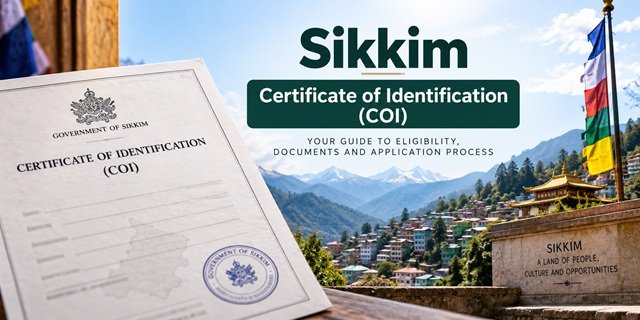
Sikkim follows a unique residence and identification system that is different from most Indian states. Instead of relying only on a traditional domicile certificate, the state issues documents such as the Certificate of Identification (COI) and the Residential Certificate (RC) for specific categories of residents. These certificates play an important role in establishing a person’s connection with Sikkim and are often required for government jobs, educational admissions, scholarships, land-related matters, and other state-specific benefits.
The Certificate of Identification (COI) is generally issued to eligible Sikkim Subjects and their descendants, while the Residential Certificate (RC) is available for certain old settlers and their descendants as per the rules notified by the Government of Sikkim. Both certificates are administered through the Revenue authorities under the Land Revenue and Disaster Management Department.
Because Sikkim has special constitutional protections under Article 371F, residence-related documentation carries significant importance within the state. Many recruitment authorities, educational institutions, and government departments use these certificates to verify eligibility for benefits reserved for recognised residents of Sikkim.
If a notification specifically asks for a COI, applicants should submit a Certificate of Identification rather than assuming that any other residence document will be accepted. Likewise, applicants seeking a Residential Certificate should verify the eligibility conditions applicable to their category before applying.
Why Does Sikkim Have a Certificate of Identification (COI)?
The origin of the Certificate of Identification is closely linked to Sikkim’s historical transition into the Indian Union. Before Sikkim became a state of India in 1975, eligible residents were issued Sikkim Subject Certificates (SSC) under the Sikkim Subjects Regulation, 1961.
After the merger of Sikkim with India, Sikkim Subject Certificates were no longer issued. To establish and verify the identity of eligible Sikkim Subjects and their descendants, the Government of Sikkim introduced the Certificate of Identification (COI). Today, the COI serves as one of the most important identification documents for many residents of the state.
The certificate is frequently required for state government recruitment, educational admissions, scholarships, reservation-related benefits, and other purposes where proof of recognised Sikkim residency or lineage is necessary.
COI vs RC vs SSC: Which Certificate Applies to You?
Sikkim’s residence and identification framework includes three commonly referenced documents: the Sikkim Subject Certificate (SSC), the Certificate of Identification (COI), and the Residential Certificate (RC). Understanding the difference between them can help you determine which document is relevant in your case.
Sikkim Subject Certificate (SSC): This certificate was issued under the Sikkim Subjects Regulation, 1961, before Sikkim became a state of India in 1975. SSCs are no longer issued today, but existing SSC records continue to play an important role when establishing eligibility for a Certificate of Identification.
Certificate of Identification (COI): The COI is one of the most important identification documents issued in Sikkim. It is generally granted to eligible Sikkim Subjects and their descendants based on supporting records such as an SSC, Parcha (land record), Indian Citizenship Certificate (ICC), or other recognised eligibility categories prescribed by the Government of Sikkim. The certificate is widely used for government recruitment, educational admissions, scholarships, and other state-specific purposes.
Residential Certificate (RC): The Residential Certificate is a separate document intended for specific categories of residents as recognised by the Government of Sikkim. Eligibility requirements, supporting documents, and administrative procedures may differ from those applicable to a COI. Applicants should always verify the latest guidelines before applying.
Before submitting an application, carefully check the exact document mentioned in the recruitment notification, admission prospectus, scholarship guideline, or government scheme. If a COI is specifically required, applicants should not assume that an RC or any other residence document will automatically be accepted.
Who Can Apply for a Certificate of Identification (COI)?
The Certificate of Identification is issued to eligible persons who can establish their connection with recognised Sikkim Subject records or other approved categories accepted by the Government of Sikkim. During verification, authorities examine the applicant’s relationship with the original record holder and the supporting documents submitted with the application.
In general, COI applications are commonly based on one of the following categories:
- Sikkim Subject Certificate (SSC): Where the applicant’s father or paternal ancestor held a valid SSC.
- Parcha (Land Record): Where eligibility is established through recognised ancestral land records maintained in Sikkim.
- Indian Citizenship Certificate (ICC): Where the applicant’s family possesses an eligible Indian Citizenship Certificate linked to Sikkim.
- Government Service Record: Where the applicant’s father or paternal ancestor served in the Government of Sikkim under the categories recognised by the competent authority.
Applicants are generally required to establish their relationship with the original record holder through supporting documents such as birth records, family records, lineage documents, or other proofs accepted during verification. Since document scrutiny is often detailed, all records should contain matching names and family information wherever possible.
Who Can Apply for a Residential Certificate (RC)?
The Residential Certificate (RC) is a separate residence-related document issued to eligible persons who were ordinarily residing in Sikkim before 26 April 1975 and, in certain cases, their descendants. The certificate is generally used where applicants need to establish long-standing residence in Sikkim but do not fall under the categories covered by the Certificate of Identification (COI).
Applicants are typically required to provide documentary evidence showing residence in Sikkim before the merger period, along with documents establishing their relationship with the original resident. Since eligibility requirements may be revised from time to time, applicants should always verify the latest instructions from the concerned District Administration before submitting an application.
If you are unsure whether you need a COI or an RC, carefully check the document requirements mentioned in the recruitment notification, admission prospectus, scholarship guidelines, or government scheme before applying.
Documents Required for Certificate of Identification (COI)
Before applying for a COI, applicants should keep all supporting documents ready. The issuing authority verifies both the applicant’s eligibility category and relationship with the original record holder before issuing the certificate.
The exact document requirement may vary depending on whether the application is based on an SSC, Parcha, ICC, or another recognised category. Commonly required documents include:
- Supporting Eligibility Record such as a Sikkim Subject Certificate (SSC), Parcha (land record), Indian Citizenship Certificate (ICC), or other recognised supporting record applicable to the applicant’s category.
- Relationship Proof establishing the applicant’s connection with the original record holder, such as a Birth Certificate, School Certificate, Transfer Certificate, family records, or other acceptable documents.
- Age Proof such as a Birth Certificate, School Leaving Certificate, Transfer Certificate, or any other officially recognised document.
- Identity Proof such as a Voter ID Card, Aadhaar Card, Passport, or any other government-issued identity document, wherever applicable.
- Recent Passport-Size Photographs as prescribed in the application form.
- Verification Report or local verification documents are required by the concerned authority during scrutiny.
- Fee Receipt or other supporting documents, if prescribed by the issuing office.
All documents should contain consistent information regarding the applicant’s name, parent’s name, and family details. Any mismatch between submitted records can delay verification or result in the application being returned for clarification.
If any supporting document contains incorrect personal details, it is advisable to update the record before applying. This helps ensure a smoother verification process and reduces the chances of objections from the issuing authority.
Applicants seeking information from government departments regarding old records, land-related documents, or certificate verification may also find our guide on RTI Application Process useful for understanding how official information can be requested from public authorities.
How to Apply for a Sikkim Certificate of Identification (COI)
Step 1: Sabse pehle apne district ke District Administrative Centre (DAC) ya Deputy Commissioner’s (DC) Office mein jaakar Certificate of Identification (COI) ke liye prescribed application form prapt karein.
Step 2: Application form ko dhyan se bharein. Form mein aapse naam, pata, janm tithi, pita ya purvaj ki jankari, aur COI ke liye aapki eligibility category (SSC, Parcha, ICC ya anya eligible category) sambandhi vivaran maanga ja sakta hai.
Step 3: Apni category ke anusar sabhi supporting documents attach karein. Ismein SSC, Parcha, ICC, relationship proof, age proof, photographs aur anya aavashyak records shamil ho sakte hain.
Step 4: Form submit karne se pehle ek baar sabhi details aur documents ko verify kar lein. Naam, family details aur document records mein kisi bhi tarah ki mismatch verification mein delay ka karan ban sakti hai.
Step 5: Pura application set concerned DAC ya DC Office mein jama karein. Submission ke baad acknowledgement receipt ya reference details sambhal kar rakhein.
Step 6: District Administration dwara documents aur eligibility ki jaanch ki jayegi. Zarurat padne par applicant se additional documents ya clarification bhi maangi ja sakti hai.
Step 7: Verification poori hone aur application approve hone ke baad competent authority dwara Certificate of Identification (COI) issue kar diya jata hai.
What Happens After You Apply?
After submitting the application, the concerned district authority examines the documents and eligibility records provided by the applicant. During this stage, the administration may verify family records, land records, identity documents, relationship proofs, and other supporting documents submitted with the application.
In certain cases, local verification or additional scrutiny may be carried out by the concerned authorities before the application is approved. If any document is missing or clarification is required, the applicant may be asked to provide additional information.
Once the verification process is completed and the competent authority is satisfied with the documents submitted, the Certificate of Identification (COI) is issued to the applicant.
Processing Time and Fee
The actual processing time may vary depending on document verification, workload, and the complexity of the case. Applicants should keep their acknowledgement receipt safely until the process is completed.
| Particular | Details |
|---|---|
| Processing Time | Approximately 30 days (subject to verification) |
| Application Fee | Prescribed fee as notified by the concerned authority |
| Issuing Authority | Additional District Collector (ADC) |
| Verification | Document and eligibility verification by competent authorities |
| Validity | Generally valid for life unless otherwise specified |
Common Problems and Their Solutions
SSC is not available:
If the original Sikkim Subject Certificate is unavailable, applicants should check whether eligibility can be established through other recognised records such as Parcha, ICC, or other documents accepted by the concerned authority.
Relationship with the original record holder cannot be established:
Birth certificates, school records, family records, and other supporting documents should be arranged carefully to establish the applicant’s connection with the original record holder.
Mismatch in names or personal details:
Differences in name spelling, date of birth, or family information across documents can delay verification. Applicants should update incorrect records before applying whenever possible.
Application is taking longer than expected:
Verification of old records sometimes requires additional scrutiny. Applicants can contact the concerned District Administration for an update on the status of their application.
Need official information or record clarification:
If you require information from a government department regarding records or administrative procedures, you may find our guide on filing an RTI application useful.
Quick Reference
| Particular | Details |
|---|---|
| Certificate Name | Certificate of Identification (COI) |
| State | Sikkim |
| Issuing Authority | Additional District Collector (ADC) |
| Administering Department | Land Revenue and Disaster Management Department |
| Application Mode | Offline through District Administration |
| Common Eligibility Basis | SSC, Parcha, ICC, or other recognised categories |
| Processing Time | Approximately 30 days |
| Validity | Lifetime / As per government rules |
| Official Portal | sikkim.gov.in |
| Department Website | sikkimlrdm.gov.in |
Frequently Asked Questions
Q. What is the Certificate of Identification (COI) in Sikkim?
Ans. The Certificate of Identification (COI) is one of the most important residence-related documents issued in Sikkim. It is generally used to establish a person’s recognised Sikkimese status based on eligible ancestral records and is often required for state government jobs, educational admissions, scholarships, and various state-specific benefits. The certificate is issued by the concerned Additional District Collector (ADC) after document verification and other prescribed checks.
Q. What is the difference between COI and the Sikkim Subject Certificate (SSC)?
Ans. The Sikkim Subject Certificate (SSC) was issued before Sikkim became a state of India in 1975 and is no longer issued today. The COI is the currently recognised document used by eligible descendants of SSC holders and other qualifying categories. In many cases, an ancestral SSC can serve as one of the supporting documents while applying for a COI.
Q. What is the difference between COI and Residential Certificate (RC)?
Ans. The COI and Residential Certificate (RC) are separate documents issued for different categories of residents. COI applications are generally based on recognised ancestral records such as SSC, Parcha, ICC, or eligible government service records. The RC was introduced for certain old-settler categories and their descendants. Applicants should always check the latest government guidelines to determine which certificate is applicable in their case.
Q. Can I apply for a COI if my family does not have an SSC?
Ans. Yes. SSC is only one of the recognised eligibility bases. Depending on your family records, a COI application may also be supported by documents such as Parcha (land records), Indian Citizenship Certificate (ICC), or qualifying government employment records. The concerned district authority will verify the documents submitted with the application.
Q. Why are relationship documents required for a COI application?
Ans. Relationship documents help the issuing authority verify the applicant’s connection with the person whose SSC, Parcha, ICC, or other qualifying record is being used as the eligibility basis. Documents such as birth certificates, school certificates, transfer certificates, or other government records may be used to establish this relationship.
Q. How long does it take to get a COI in Sikkim?
Ans. The processing time may vary depending on document verification and district-level procedures. In many cases, the process can take around one month, but applicants should contact their District Administrative Centre (DAC) or ADC office for the latest timelines.
Q. Is the COI valid for a limited period?
Ans. Generally, the Certificate of Identification is treated as a long-term document and does not require frequent renewal. However, applicants should verify the latest rules and usage requirements with the issuing authority whenever the certificate is required for an official purpose.
Q. Where can I get help if I face issues during the application process?
Ans. You can contact the concerned District Administrative Centre (DAC), Additional District Collector (ADC) office, or the Land Revenue and Disaster Management Department for assistance. If you need information from a government department, you may also refer to our guide on the Sikkim RTI Application Process. For public grievance-related matters, you can check our detailed guide on the Sikkim CM Helpline.

Tabassum is a government document researcher and writer with over 5 years of experience exclusively dedicated to tracking and simplifying Central and State Government document processes across India. She has researched and published detailed guides on 100+ government documents and certificates – including Aadhaar Card, PAN Card, Ration Card, Domicile Certificate, and Birth Certificate – covering all states and the Central Government, helping lakhs of Indian citizens successfully complete their paperwork in simple, easy-to-understand language.