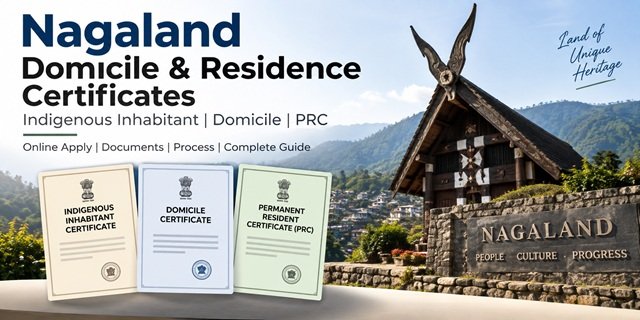
The Nagaland Domicile Certificate is an official document issued by the Government of Nagaland to certify that a person is domiciled in or has established residence within the state. It is commonly required for educational admissions, government services, recruitment processes, scholarships, and other situations where proof of residence in Nagaland is needed.
Citizens can apply online through the Nagaland Unified Services Portal at services.nagaland.gov.in, where the Domicile Certificate is available as an official service under the Home Department. The portal allows applicants to submit applications digitally and access multiple government services from a single platform.
Many people confuse the Domicile Certificate with the Indigenous Inhabitant Certificate (IIC). Although both documents are related to residence and identity within Nagaland, they serve different purposes and are issued as separate services. Before applying, always check the exact certificate mentioned in your recruitment notification, admission brochure, scholarship guidelines, or departmental instructions.
Domicile Certificate vs Indigenous Inhabitant Certificate (IIC)
The Nagaland Unified Services Portal provides separate services for the Domicile Certificate and the Indigenous Inhabitant Certificate (IIC). Applicants should not assume that one certificate will automatically be accepted in place of the other.
Domicile Certificate: Used as proof of domicile or residence in Nagaland for various educational, administrative, recruitment, and service-related purposes where a residence certificate is required.
Indigenous Inhabitant Certificate (IIC): Issued to establish indigenous inhabitant status as recognized by the Government of Nagaland. This certificate is often required where indigenous status must be specifically verified.
A simple rule can help avoid rejection:
- If the notification specifically asks for a Domicile Certificate, apply for the Domicile Certificate service.
- If the notification specifically asks for an Indigenous Inhabitant Certificate (IIC), apply for the IIC service.
- If you are unsure, carefully read the eligibility conditions and document requirements mentioned in the official notification.
Submitting the wrong certificate can delay admissions, scholarship verification, recruitment processes, or document scrutiny. Therefore, always verify the exact requirements before submitting your application.
Nagaland’s ILP System and Its Connection to Residence Certificates
Nagaland follows the Inner Line Permit (ILP) system under the Bengal Eastern Frontier Regulation, 1873. Indian citizens who are not indigenous inhabitants of Nagaland generally require an ILP before entering the state. Applications can be submitted through the official ILP portal at ilp.nagaland.gov.in.
Several categories of ILP are available, including permits for tourists, students, labourers, teachers, priests, traders, and businesspersons. The validity period, eligibility conditions, and applicable fees vary depending on the category selected.
One important point is that certain long-duration permit categories may require applicants to submit proof showing continuous residence within Nagaland. In such cases, certificates issued by the concerned district administration can play an important role during verification. This is one reason why residence-related documents such as a Domicile Certificate or Permanent Resident Certificate may be required by some applicants already living and working in the state.
While the ILP is primarily meant for regulating the entry and stay of non-residents, residence certificates serve a completely different purpose. They are used to establish a person’s residential status within Nagaland for admissions, government services, employment-related documentation, and other official requirements.
If your purpose is to enter Nagaland temporarily, you should check the ILP requirements. However, if an institution, department, or authority has specifically asked for proof of residence in Nagaland, you should apply for the appropriate residence-related certificate through the official state services portal.
Who Is Eligible for the Indigenous Inhabitant Certificate?
The Indigenous Inhabitant Certificate is issued to persons who are recognised as indigenous inhabitants of Nagaland under the rules and guidelines prescribed by the Government of Nagaland. This certificate is primarily intended for members of recognised indigenous communities of the state and is commonly required for benefits, reservations, recruitments, and opportunities specifically reserved for indigenous inhabitants.
Applicants must be able to establish their indigenous status through the documents and verification process prescribed by the competent authority. During scrutiny, authorities may verify family records, community records, village records, and other supporting documents wherever required.
Individuals who are residents of Nagaland but do not qualify as indigenous inhabitants should generally apply for the Domicile Certificate or Permanent Resident Certificate (PRC), depending on the document specifically required by the concerned department, institution, recruitment authority, or scheme.
Because eligibility requirements may vary based on the certificate being applied for, applicants should carefully read the service description available on the official Nagaland Services Portal before submitting their application.
Documents Required
Before applying for a certificate in Nagaland, keep all supporting documents ready in scanned format. Clear and readable documents help the concerned authority verify your application faster and reduce the chances of delays.
- Proof of Date of Birth (any one):
- Birth Certificate
- School Admit Card or Board Examination Admit Card
- Any other government-recognised date of birth document
- Residence Proof (any one):
- Voter ID Card (EPIC)
- Ration Card
- Electricity Bill
- Telephone Bill
- Patta or Land Allotment Document
- Any other valid address or residence proof accepted by the authority
- Educational Qualification Certificate (latest or highest qualification available)
- Village Council or Gaonbura Certificate confirming the applicant’s village residence, family background, and community affiliation, wherever applicable.
- Parent’s Indigenous Inhabitant Certificate (if available) to support family lineage and indigenous inhabitant status.
- Scheduled Tribe (ST) Certificate of the applicant or parent, wherever applicable.
- Recent Passport-Size Photograph
Depending on the certificate being applied for and the applicant’s individual circumstances, the issuing authority may ask for additional documents or clarification during verification. Applicants should ensure that their name, address, and family details remain consistent across all submitted records.
How to Apply Online Through the Nagaland Services Portal
Step 1: Visit the official Nagaland Services Portal at services.nagaland.gov.in. On the homepage, click Sign Up if you are a new user. Enter your name, mobile number, email ID, and other required details to create an account.
Step 2: After registration, log in using your username and password. Once you enter the dashboard, use the search box and type Domicile Certificate, Permanent Resident Certificate (PRC), or the certificate you want to apply for.
Step 3: Click on the relevant service and carefully read the eligibility conditions, document requirements, and instructions displayed on the screen before proceeding.
Step 4: Fill in the online application form. Enter your name, date of birth, father’s or guardian’s name, complete residential address, village or town details, district, mobile number, and other information exactly as mentioned in your supporting documents.
Step 5: Upload clear scanned copies of all required documents. Make sure the documents are readable and the information matches the details entered in the application form.
Step 6: Review the application carefully before submission. Check spellings, address details, document uploads, and contact information to avoid verification delays.
Step 7: Click Submit. After successful submission, an Application Reference Number (ARN) will be generated. Save this number carefully because it will be required later to track your application status and download the certificate.
Step 8: The concerned authority will verify your application and supporting documents. Once approved, the certificate can be downloaded online through the portal.
How to Apply Through a CSC Centre
Step 1: Visit your nearest Common Service Centre (CSC) with all original documents and photocopies.
Step 2: Inform the CSC operator that you want to apply for a Nagaland Domicile Certificate or Permanent Resident Certificate.
Step 3: The operator will fill out the online application form and upload your documents on the government portal.
Step 4: Verify all details before submission, including your name, address, date of birth, and mobile number.
Step 5: After submission, collect the acknowledgement receipt containing your Application Reference Number.
Step 6: Use the reference number to track the application and download the certificate after approval.
How to Apply at the DC Office
Step 1: Visit the Deputy Commissioner’s (DC) Office of your district during working hours.
Step 2: Request the application form for the certificate you want to obtain and collect information about the required documents.
Step 3: Fill in the application form carefully and attach photocopies of all supporting documents.
Step 4: Submit the completed application at the designated counter and present original documents if verification is required.
Step 5: Collect the acknowledgement receipt or reference number issued by the office.
Step 6: After verification and approval by the concerned authority, collect the certificate or download it online if digital access is provided.
How to Track Your Application
After submitting your application, you can monitor its progress online without visiting the office repeatedly.
Step 1: Visit the official Nagaland Services Portal and log in to your account.
Step 2: Open the Track Application or Application Status section available in your dashboard.
Step 3: Enter your Application Reference Number (ARN) if required.
Step 4: The system will display the latest status of your application, such as Submitted, Under Verification, Approved, or Rejected.
Step 5: Applicants may also receive updates on their registered mobile number or email ID during different stages of processing.
If your application remains pending for an unusually long period, you may contact the concerned Deputy Commissioner’s office for clarification.
Processing Time and Fee
The Government of Nagaland provides residence-related certificate services through its online platform. After submission, the application is verified by the concerned district authorities before approval.
| Particular | Details |
|---|---|
| Certificate Types | Indigenous Inhabitant Certificate, Domicile Certificate, Permanent Resident Certificate (PRC) |
| Application Fee | Free of Cost |
| Government Charges | Nil |
| CSC Service Charges | May apply if using a CSC |
| Processing Authority | Deputy Commissioner (DC) / Assistant Deputy Commissioner (ADC) |
| Processing Time | Depends on document verification and approval by the concerned authority |
| Certificate Validity | Generally Permanent |
Common Problems and Their Solutions
Village Council or Gaonbura certificate is unavailable:
Many Indigenous Inhabitant Certificate applications rely on verification from the Village Council or Gaonbura. If you do not have this document, contact your village authority and obtain the required certificate before applying.
Confused between Indigenous Inhabitant Certificate, Domicile Certificate, and PRC:
Always apply for the exact certificate mentioned in the recruitment notification, admission guideline, scholarship rules, or government scheme. These certificates serve different purposes and may not always be interchangeable.
Documents do not match:
Differences in name spelling, address, date of birth, or family details across documents can delay verification. Ensure all records are updated and consistent before submitting the application.
Application is stuck in verification:
Verification may take additional time if authorities require further scrutiny or supporting documents. Keep your Application Reference Number handy and contact the concerned DC Office if the delay becomes excessive.
Unable to apply online:
If you face technical issues or are not comfortable using the portal, you can submit the application through a nearby CSC Centre or directly at the Deputy Commissioner’s office.
Need help with government services or grievances:
For citizen grievances and public service issues, you may find our Nagaland CM Helpline Guide useful. If you need government records or public information, you can also read our RTI in Nagaland Guide.
Quick Reference
| Particular | Details |
|---|---|
| State | Nagaland |
| Certificate Types | Indigenous Inhabitant Certificate, Domicile Certificate, Permanent Resident Certificate (PRC) |
| Official Services Portal | services.nagaland.gov.in |
| ILP Portal | ilp.nagaland.gov.in |
| DPAR Website | dpar.nagaland.gov.in |
| Application Mode | Online, CSC, DC Office |
| Issuing Authority | Deputy Commissioner (DC) / Assistant Deputy Commissioner (ADC) |
| Government Fee | Free |
| Validity | Generally Permanent |
| Related Resource | Nagaland CM Helpline Guide |
| RTI Guide | RTI in Nagaland |
Frequently Asked Questions
Q. What is the Indigenous Inhabitant Certificate in Nagaland?
Ans. The Indigenous Inhabitant Certificate is an official document issued to recognised indigenous inhabitants of Nagaland. It is commonly required for state government recruitments, educational admissions, scholarships, reservations, and other benefits meant specifically for indigenous inhabitants of the state. The certificate is issued by the district administration after verification of eligibility and supporting documents.
Q. What is the difference between an Indigenous Inhabitant Certificate, a Domicile Certificate, and a PRC?
Ans. These are separate services available through the Nagaland Government. The Indigenous Inhabitant Certificate is meant for recognised indigenous inhabitants of Nagaland, while the Domicile Certificate and Permanent Resident Certificate (PRC) may be required for residence-related purposes depending on the specific rules of the department, institution, recruitment authority, or scheme. Always apply for the exact certificate mentioned in the official notification.
Q. Can I apply for a Nagaland Domicile Certificate or PRC online?
Ans. Yes. Applications can be submitted through the official Nagaland Services Portal. Citizens can complete the application process online, upload documents, track application status, and access services without visiting government offices repeatedly.
Q. I am a non-Naga resident living in Nagaland. Which certificate should I apply for?
Ans. Non-indigenous residents should generally apply for the Domicile Certificate or Permanent Resident Certificate (PRC), depending on the document specifically required by the concerned authority. The Indigenous Inhabitant Certificate is intended for recognised indigenous inhabitants of Nagaland.
Q. Why is a Village Council or Gaonbura certificate important?
Ans. In many cases, the Village Council or Gaonbura certificate helps establish an applicant’s village residence, family background, and community affiliation. The concerned authority may rely on such certificates during verification, particularly for Indigenous Inhabitant Certificate applications.
Q. Is there any fee for applying?
Ans. Residence-related certificate services are generally provided free of government charges. However, if you apply through a Common Service Centre (CSC), the operator may charge a service fee for assisting with the online application process.
Q. How can I track my application status?
Ans. After submitting the application, you can log in to the official Nagaland Services Portal and use your Application Reference Number (ARN) to check the latest status of your application online.
Q. What should I do if my application is rejected?
Ans. Check the reason for rejection carefully. Applications are commonly rejected because of incomplete information, document mismatches, or insufficient supporting records. After correcting the issue, you can submit a fresh application with the required documents.
Q. Can I apply through a CSC if I am unable to use the portal myself?
Ans. Yes. You can visit a nearby CSC with your documents. The operator will complete the online application on your behalf and provide an acknowledgement receipt containing your Application Reference Number.
Q. Where can I get help regarding government services or grievances in Nagaland?
Ans. For public grievances and citizen service-related issues, you can refer to our Nagaland CM Helpline Guide. If you need information from government departments, you may also find our RTI in Nagaland Guide helpful.

Tabassum is a government document researcher and writer with over 5 years of experience exclusively dedicated to tracking and simplifying Central and State Government document processes across India. She has researched and published detailed guides on 100+ government documents and certificates – including Aadhaar Card, PAN Card, Ration Card, Domicile Certificate, and Birth Certificate – covering all states and the Central Government, helping lakhs of Indian citizens successfully complete their paperwork in simple, easy-to-understand language.