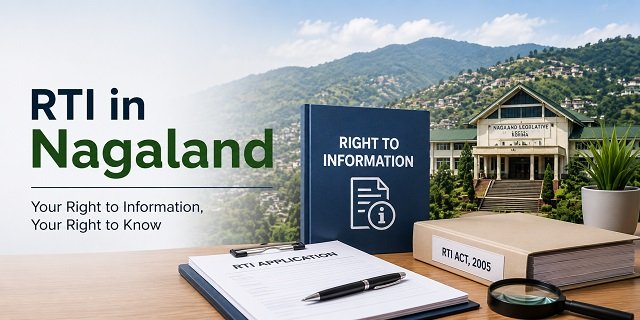
Nagaland currently does not provide a functional online RTI portal for filing RTI applications to State Government public authorities. Citizens who wish to obtain information under the Right to Information Act, 2005 must generally submit their RTI application offline to the concerned Public Information Officer (PIO) by post or in person. The application fee and procedure are governed by the Nagaland Right to Information Rules notified under Section 27 of the RTI Act. The prescribed application fee is Rs 10, which may be paid through the modes permitted under the Rules, such as Indian Postal Order (IPO), Demand Draft or Cash against receipt, wherever accepted.
RTI applications may be submitted in English, the official language used for government communication in Nagaland. The Department of Information and Public Relations (DIPR) has also translated the RTI Act into Konyak and Phom tribal languages to improve awareness of the law among local communities. First Appeals, Second Appeals and complaints are generally submitted through the prescribed offline procedure before the competent authorities.
Second Appeals and complaints relating to Nagaland State Government public authorities are handled by the Nagaland Information Commission (NIC) in accordance with the RTI Act and the applicable Rules. Before filing a Second Appeal or complaint, applicants should first complete the prescribed RTI application and First Appeal process, wherever required.
For RTI applications relating to Central Government ministries, departments and organisations such as UIDAI, EPFO, Passport Office, Nagaland University and other Central Public Authorities, applicants should use the Central RTI Online Portal, wherever applicable. For a complete overview of the RTI process across India, read our RTI Online India Guide.
Nagaland’s RTI Context: Tribal Languages and Governance
Nagaland is home to several Naga tribes, each with its own language or dialect. English is the official language of the State and is widely used for government administration and official correspondence. To improve public awareness of the Right to Information Act, 2005, the Department of Information and Public Relations (DIPR) has translated the Act into the Konyak and Phom tribal languages, making RTI information more accessible to local communities.
Like other States, public authorities in Nagaland are required to maintain transparency and proactively disclose information under Section 4 of the RTI Act, 2005. Citizens may seek information relating to government departments, public services, welfare schemes, recruitment, public expenditure, development projects and other records held by public authorities, subject to the exemptions provided under Section 8 and other applicable provisions of the RTI Act.
State or Central RTI? Choose the Correct Public Authority
If the information is held by a Nagaland State Government department, local authority or State public body, submit your RTI application to the concerned Public Information Officer (PIO) under the prescribed offline procedure. Examples include:
- Department of Revenue and Land Records
- Nagaland Police (subject to the RTI Act and applicable exemptions)
- Nagaland Power Distribution Corporation Limited (NPDCL)
- Department of Public Works (Roads and Bridges)
- Nagaland Public Service Commission (NPSC)
- Municipal Councils and other Urban Local Bodies
- Village Development Boards (VDBs) and other State public authorities
- Department of Social Welfare
- School Education Department
- Health & Family Welfare Department
- Department of Underdeveloped Areas (DUDA)
- Department of Environment, Forests & Climate Change
- Department of Agriculture
- Department of Art & Culture
If the information relates to a Central Government ministry, department, statutory authority or Central Public Sector Enterprise, file your RTI application through the Central RTI Online Portal, wherever applicable. Examples include:
- Income Tax Department
- Employees’ Provident Fund Organisation (EPFO)
- UIDAI (Aadhaar)
- Passport Seva
- North East Frontier Railway (NFR)
- North Eastern Electric Power Corporation (NEEPCO)
- Assam Rifles, CRPF and other Central Armed Police Forces (subject to applicable RTI exemptions)
- National Institute of Technology (NIT) Nagaland
- Nagaland University
Nagaland RTI Fee and Payment Modes
The fee payable for obtaining information under the Right to Information Act, 2005 in Nagaland is prescribed under the Nagaland Right to Information Rules.
- RTI application fee: Rs 10
- Photocopies (A4 or A3): Rs 2 per page
- Larger-size documents: Actual cost of copying
- Information on CD: Rs 50 per CD
- Inspection of records: Rs 10 for the first hour and Rs 5 for every additional 15 minutes or part thereof
- Maps, plans and other materials: Actual reproduction cost, as determined under the Rules
- First Appeal: No fee
- Second Appeal: No fee
BPL applicants: Citizens holding a valid Below Poverty Line (BPL) certificate are exempt from paying the RTI application fee under Section 7(5) of the RTI Act. A copy of the valid BPL certificate should be enclosed with the application.
Accepted payment modes generally include:
- Indian Postal Order (IPO)
- Demand Draft (DD)
- Cash against an official receipt, wherever accepted by the concerned public authority
How to Submit an RTI Application Offline in Nagaland
Since Nagaland does not currently provide a functional online RTI portal for State Government departments, RTI applications are generally submitted offline by post or in person.
Step 1: Identify the Government department or public authority that holds the information you need. Send your RTI application to the Public Information Officer (PIO) of that department.
Step 2: Prepare your RTI application in English. Clearly mention the information or records you want to obtain and include your name and complete postal address so that the department can send you a reply.
Step 3: Pay the prescribed Rs 10 RTI application fee using one of the payment methods permitted under the Nagaland Right to Information Rules. If you are eligible for the BPL fee exemption, attach a copy of your valid BPL certificate instead of paying the fee.
Step 4: Attach the fee proof (if applicable) along with your RTI application and keep a photocopy or scanned copy of all the documents for your records.
Step 5: Send the application to the concerned Public Information Officer (PIO) by post or submit it personally at the office of the public authority. If you submit it in person, ask for an acknowledgement or receipt.
Step 6: If you send the application by post, keep the postal receipt safely so that you can track the delivery and use it as proof of submission, if required.
Submitting an RTI Application in Person
If you prefer to submit your RTI application personally, visit the office of the concerned Public Information Officer (PIO) during office hours. Submit your application along with the prescribed fee or BPL certificate, collect an acknowledgement or receipt, and keep it safely for future reference.
RTI Response Time in Nagaland
Once the concerned Public Information Officer (PIO) receives your RTI application, the time limits prescribed under the Right to Information Act, 2005 apply.
- 30 days: The PIO should provide the requested information or communicate the reasons for rejection within 30 days.
- 48 hours: Where the requested information concerns the life or liberty of a person.
- Transfer within 5 days: If the application is sent to the wrong public authority, it should be transferred to the appropriate public authority under Section 6(3) of the RTI Act.
How to File the First Appeal in Nagaland
If you do not receive any reply within the prescribed time or you are dissatisfied with the information provided, you have the right to file a First Appeal under Section 19(1) of the RTI Act.
Step 1: Address your appeal to the First Appellate Authority (FAA) of the same department or public authority where you submitted your RTI application.
Step 2: Mention the details of your original RTI application, including the application date and the reason for filing the appeal, such as non-receipt of information, incomplete information or rejection of the request.
Step 3: Attach copies of the relevant documents, such as your RTI application, proof of submission, fee receipt (if applicable) and the reply received from the PIO, if any.
Step 4: Submit the First Appeal by post or in person to the concerned First Appellate Authority (FAA) and keep the acknowledgement or postal receipt safely.
Time limit for filing: The First Appeal should normally be filed within 30 days from the date of receiving the PIO’s decision or from the date on which the reply was due.
Appeal fee: No fee is payable for filing a First Appeal.
Decision by the FAA: The First Appellate Authority should ordinarily dispose of the appeal within 30 days. For recorded reasons, this period may be extended up to 45 days.
How to File a Second Appeal in Nagaland
If you are not satisfied with the decision of the First Appellate Authority (FAA), or if no decision is received within the prescribed time, you may file a Second Appeal before the Nagaland Information Commission (NIC) under Section 19(3) of the RTI Act.
Step 1: Prepare your Second Appeal and clearly explain why you are dissatisfied with the decision of the First Appellate Authority or why no decision was received.
Step 2: Attach copies of all the relevant documents, including your RTI application, proof of submission, the First Appeal and the order of the First Appellate Authority, if available.
Step 3: Submit the Second Appeal to the Nagaland Information Commission by post or in person and keep the postal receipt or acknowledgement safely for future reference.
Time limit: A Second Appeal should normally be filed within 90 days from the date of the First Appellate Authority’s decision or from the date on which the decision was due. The Commission may admit an appeal filed after this period if sufficient cause for the delay is shown.
Appeal fee: No fee is payable for filing a Second Appeal before the Nagaland Information Commission.
Documents Required for a Second Appeal
- Copy of the original RTI application
- Proof of submission of the RTI application
- Copy of the First Appeal
- Order of the First Appellate Authority, if available
- Any reply received from the Public Information Officer (PIO), if applicable
- Copies of any other supporting documents relevant to the appeal
How to File a Complaint Before the Nagaland Information Commission
In certain situations, you may file a Complaint before the Nagaland Information Commission (NIC) under Section 18 of the Right to Information Act, 2005. A complaint is generally filed when you are unable to submit an RTI application or when the provisions of the RTI Act have not been followed by the concerned public authority.
You may file a complaint if:
- The Public Information Officer (PIO) refuses to accept your RTI application.
- No Public Information Officer has been appointed by the public authority.
- You are denied access to information without following the provisions of the RTI Act.
- You are charged an unreasonable fee for providing information.
- You believe there has been any other violation of your rights under the RTI Act.
Step 1: Prepare a written complaint explaining the issue clearly and include all relevant facts.
Step 2: Attach copies of the supporting documents, if available, such as your RTI application, correspondence with the public authority, fee receipt or any other relevant records.
Step 3: Submit the complaint to the Nagaland Information Commission by post or in person and keep the acknowledgement or postal receipt safely for future reference.
Complaint fee: No fee is payable for filing a complaint before the Nagaland Information Commission.
Helpful Tips for Filing an RTI in Nagaland
- Identify the correct Public Information Officer (PIO) before submitting your RTI application.
- Write your RTI application clearly in English, which is the official language used for government communication in Nagaland.
- Ask for specific records or documents instead of seeking explanations or opinions.
- Keep copies of your RTI application, payment proof and acknowledgement for future reference.
- If you do not receive a reply within the prescribed time, file a First Appeal under the RTI Act.
- Use the Central RTI Online Portal only for Central Government public authorities. RTI applications for Nagaland State Government departments are generally submitted offline.
Quick Reference
| Particular | Details |
|---|---|
| State RTI Application | Offline (Post or In Person) |
| State RTI Portal | Not Available |
| Nagaland Information Commission | nlsic.nagaland.gov.in |
| Nagaland Government Portal | nagaland.gov.in |
| Central RTI Portal | rtionline.gov.in |
| RTI Application Fee | Rs 10 |
| Photocopy Charges | Rs 2 per page (A4/A3) |
| CD Charges | Rs 50 per CD |
| First Appeal Fee | No Fee |
| Second Appeal Fee | No Fee |
| Accepted Payment Modes | IPO, Demand Draft or Cash (where accepted) |
| Language | English |
| RTI Act Translation | Konyak and Phom languages (for public awareness) |
Frequently Asked Questions
Q. Is there an online RTI portal for Nagaland State Government departments?
Ans. No. Nagaland does not currently provide a functional online RTI portal for filing RTI applications to State Government public authorities. RTI applications are generally submitted offline to the concerned Public Information Officer (PIO) by post or in person.
Q. In which language can I submit an RTI application in Nagaland?
Ans. RTI applications are generally submitted in English, which is the official language used for government communication in Nagaland. The RTI Act has also been translated into the Konyak and Phom languages to improve public awareness.
Q. How can I file a First Appeal in Nagaland?
Ans. If you do not receive a reply within the prescribed time or you are not satisfied with the decision of the Public Information Officer (PIO), you may file a First Appeal with the First Appellate Authority (FAA) of the same public authority. No fee is payable for filing a First Appeal.
Q. Where should I file a Second Appeal or Complaint?
Ans. Second Appeals and complaints relating to Nagaland State Government public authorities should be submitted to the Nagaland Information Commission (NIC) in accordance with the provisions of the RTI Act.
Q. Can I seek information from a Village Development Board (VDB) under the RTI Act?
Ans. Yes. Where a Village Development Board (VDB) functions as a public authority under the RTI Act, citizens may seek information relating to development works, expenditure, beneficiary lists and other official records from the competent authority responsible for maintaining those records.
Q. Should I use the Nagaland RTI process or the Central RTI Online Portal?
Ans. Use the offline RTI process for Nagaland State Government departments. For Central Government ministries, departments and organisations such as UIDAI, EPFO, Passport Seva, Nagaland University, NIT Nagaland and other Central Public Authorities, use the Central RTI Online Portal, wherever applicable.
Q. Where can I find the Nagaland Information Commission?
Ans. You can visit the official Nagaland Information Commission website for information relating to the Commission and RTI matters in the State.

Tabassum is a government document researcher and writer with over 5 years of experience exclusively dedicated to tracking and simplifying Central and State Government document processes across India. She has researched and published detailed guides on 100+ government documents and certificates – including Aadhaar Card, PAN Card, Ration Card, Domicile Certificate, and Birth Certificate – covering all states and the Central Government, helping lakhs of Indian citizens successfully complete their paperwork in simple, easy-to-understand language.