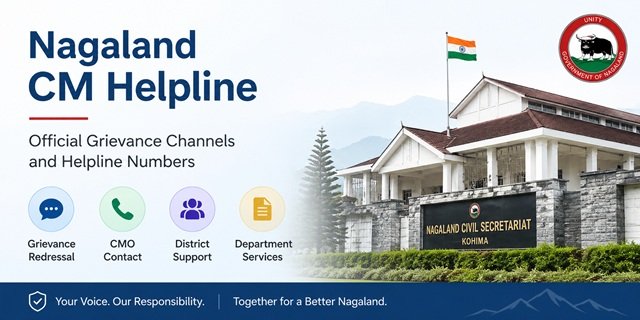
Unlike several other states, the Government of Nagaland does not operate a dedicated CM Helpline portal or a separate online Chief Minister grievance system. Instead, the official Nagaland State Portal directs citizens who wish to raise a public grievance to the Central Public Grievance Redress and Monitoring System (CPGRAMS). Through this portal, citizens can submit grievances relating to both Central Government organisations and Nagaland State Government departments.
For matters that require the attention of the Chief Minister’s Office, citizens may contact the Chief Minister’s Secretariat, Government of Nagaland directly. The official contact numbers are 0370-2270119, 0370-2270097, and 0370-2270059. The official email address is cmngl@nic.in. In addition, the Department of Personnel & Administrative Reforms (DPAR), Government of Nagaland, has issued official instructions for handling public grievances through CPGRAMS, making it the state’s primary online grievance redressal platform.
For complaints relating to ration cards and the Public Distribution System (PDS), the Department of Food & Civil Supplies operates its own grievance mechanism with dedicated helpline numbers. At the district level, the Additional Deputy Commissioner (Headquarters) functions as the District Grievance Redressal Officer (DGRO) for matters relating to food security and the Public Distribution System.
For CM Helpline portals across all states, read our CM Helpline India guide. For Right to Information services in Nagaland, read our Nagaland RTI guide.
What You Can Complain About
Since Nagaland uses CPGRAMS as its primary online public grievance platform, citizens can submit complaints relating to the functioning of Nagaland State Government departments and public services. Common grievance categories include:
- Ration card and Public Distribution System (PDS) issues, including delays, card corrections, and fair price shop complaints.
- Revenue and land administration matters, including delays in mutation, land records, or other revenue services.
- Delays in receiving pensions, scholarships, or other State Government welfare benefits.
- MGNREGS-related grievances, such as pending wages, job card issues, or work allocation.
- Electricity supply, billing, or service-related complaints against the concerned power authorities.
- Public health services, Government hospitals, medicines, or healthcare facilities.
- Education-related grievances, including Government schools, scholarships, and education department services.
- Complaints regarding negligence, delay, misconduct, or corruption involving Government officials.
- Any other State Government service that has not been delivered properly or within a reasonable time.
What Complaints Are Not Accepted?
Certain matters are generally not examined through the public grievance mechanism. Instead, they should be taken up through the appropriate legal or statutory process.
- Matters that are pending before any court of law (sub judice cases).
- Applications or requests under the Right to Information (RTI) Act.
- Personal or family disputes that do not involve a Government department.
- Service matters of Government employees where a separate statutory remedy is available.
- Incomplete grievances that do not contain sufficient information for examination.
Contact the Chief Minister’s Office (CMO)
Although Nagaland does not operate a dedicated CM Helpline portal, citizens can contact the Chief Minister’s Secretariat for matters that require the attention of the Chief Minister’s Office.
- Phone: 0370-2270119
- Alternate Phones: 0370-2270097, 0370-2270059
- Email: cmngl@nic.in
- Official Website: chiefminister.nagaland.gov.in
- Office: Chief Minister’s Secretariat, Nagaland Civil Secretariat, Kohima – 797004
If you contact the Chief Minister’s Office by email or submit a written representation, include your full name, address, mobile number, the department concerned, and a clear description of the grievance. Attach supporting documents wherever applicable.
Visit the District Administration
Many public grievances can also be resolved locally through the concerned District Administration. If your issue relates to a district office, local development work, public services, or revenue matters, you may submit a written application to the Deputy Commissioner (DC) or the concerned district office.
For grievances relating to the Public Distribution System (PDS), the designated District Grievance Redressal Officer (DGRO) functions under the district administration.
Department-Specific Grievance Mechanisms
Some Government departments operate their own grievance systems. Whenever a department provides a dedicated complaint mechanism, citizens should use that channel before escalating the matter.
- Food & Civil Supplies: Complaints relating to ration cards, fair price shops, or the Public Distribution System can be submitted through the Department of Food & Civil Supplies.
- Police: Law and order or police-related complaints should be reported through the Nagaland Police.
- Electricity: Electricity supply and billing issues should be reported to the concerned power authorities.
- Health, Education, Revenue and other departments: Department-specific grievances should first be raised before the concerned office wherever possible.
File an Online Complaint Through CPGRAMS
Since Nagaland does not have a dedicated online CM grievance portal, the official online platform for lodging public grievances is the Central Public Grievance Redress and Monitoring System (CPGRAMS) at pgportal.gov.in. The Government of Nagaland has also adopted CPGRAMS for handling public grievances through its departments.
Step 1: Visit pgportal.gov.in and click “Lodge Public Grievance”.
Step 2: Register if you are a new user or log in using your existing account.
Step 3: Select the appropriate Nagaland Government department from the available list.
Step 4: Enter complete details of your grievance, including the problem, location, department involved, and the relief you are seeking.
Step 5: Upload supporting documents, if available.
Step 6: Submit the grievance. The system generates a unique registration number which can be used to track the complaint online.
Step 7: Visit the “View Status” section on CPGRAMS anytime to check the latest action taken on your grievance.
Filing a Ration Card or PDS Complaint
If your grievance relates to the Public Distribution System (PDS), ration cards, fair price shops, or NFSA benefits, you should first approach the Department of Food & Civil Supplies, Government of Nagaland.
Step 1: Visit the official Food & Civil Supplies portal at fcs.nagaland.gov.in.
Step 2: Check whether your grievance can be resolved through the department’s online services or the concerned district office.
Step 3: If the issue remains unresolved, contact the concerned district office or the designated District Grievance Redressal Officer (DGRO) for assistance.
Step 4: If required, escalate the matter through CPGRAMS by selecting the Department of Food & Civil Supplies, Government of Nagaland.
Approach the District Administration
For local administrative issues, land matters, certificates, public infrastructure, or district-level Government services, you may also approach the office of the Deputy Commissioner (DC) of your district.
Submit a written application describing your grievance along with copies of supporting documents. The District Administration may forward the matter to the concerned department for appropriate action.
Complaints Relating to Corruption
If your grievance involves corruption, bribery, misuse of official position, or serious misconduct by a Government official, you may approach the appropriate vigilance authorities or submit the grievance through CPGRAMS by selecting the concerned department.
Escalation Process
- Step 1: First contact the concerned Government department or district office.
- Step 2: If the issue is not resolved, submit your grievance through CPGRAMS.
- Step 3: For matters requiring higher-level attention, contact the Chief Minister’s Secretariat.
- Step 4: Continue following up using your CPGRAMS registration number until the grievance is disposed of.
Quick Reference
| Service | Details |
|---|---|
| Official State Portal | nagaland.gov.in |
| Chief Minister’s Office | chiefminister.nagaland.gov.in |
| CPGRAMS | pgportal.gov.in |
| Lodge Grievance | Lodge Public Grievance |
| Track Grievance | View Grievance Status |
| CMO Phone | 0370-2270119, 0370-2270097, 0370-2270059 |
| CMO Email | cmngl@nic.in |
| Food & Civil Supplies | fcs.nagaland.gov.in |
| Department of Personnel & Administrative Reforms | dpar.nagaland.gov.in |
| Chief Secretary Portal | chiefsecretary.nagaland.gov.in |
Frequently Asked Questions
Q. Does Nagaland have a dedicated CM Helpline portal?
Ans. No. The Government of Nagaland does not currently operate a dedicated CM Helpline portal or a separate online Chief Minister grievance system. Citizens can submit online grievances through the Central Public Grievance Redress and Monitoring System (CPGRAMS) or contact the Chief Minister’s Secretariat using its official contact details.
Q. How can I file an online complaint against a Nagaland Government department?
Ans. Visit pgportal.gov.in, register or log in, choose the appropriate Nagaland Government department, enter the details of your grievance, upload supporting documents if required, and submit the complaint. Save the registration number generated by the portal for future tracking.
Q. How can I contact the Chief Minister’s Secretariat?
Ans. You can contact the Chief Minister’s Secretariat through the official phone numbers 0370-2270119, 0370-2270097, or 0370-2270059. The official email address is cmngl@nic.in. Contact details are available on the official website at chiefminister.nagaland.gov.in.
Q. Can I track my complaint after submitting it on CPGRAMS?
Ans. Yes. After submitting your grievance, CPGRAMS generates a unique registration number. You can use this number to check the latest status through the View Status section of the portal.
Q. Where should I file a ration card or Public Distribution System (PDS) complaint?
Ans. Complaints relating to ration cards, fair price shops, or the Public Distribution System should first be taken up with the Department of Food & Civil Supplies, Government of Nagaland. If the matter remains unresolved, you may escalate it through CPGRAMS.
Q. Can I approach the District Administration with my grievance?
Ans. Yes. For local administrative issues, land matters, public services, or district-level Government departments, you may submit a written representation to the office of the Deputy Commissioner (DC) of your district along with supporting documents.
Q. Can I submit a corruption complaint through CPGRAMS?
Ans. Yes. If your grievance relates to misconduct or corruption by a Government official, you may submit the complaint through CPGRAMS by selecting the concerned department and providing complete supporting details.
Q. Is there any fee for filing a grievance?
Ans. No. Filing a grievance through CPGRAMS or submitting a representation to the concerned Government authority is free of charge.
Q. Can I use CPGRAMS for complaints against Central Government departments?
Ans. Yes. CPGRAMS accepts grievances relating to both Central Government ministries and organizations as well as participating State Government departments, including those of Nagaland.
Q. What details should I keep ready before submitting a grievance?
Ans. Keep your name, contact details, the name of the concerned department, a clear description of the issue, relevant dates, and supporting documents ready. Providing complete and accurate information helps the concerned authority examine your grievance more efficiently.

Tabassum is a government document researcher and writer with over 5 years of experience exclusively dedicated to tracking and simplifying Central and State Government document processes across India. She has researched and published detailed guides on 100+ government documents and certificates – including Aadhaar Card, PAN Card, Ration Card, Domicile Certificate, and Birth Certificate – covering all states and the Central Government, helping lakhs of Indian citizens successfully complete their paperwork in simple, easy-to-understand language.