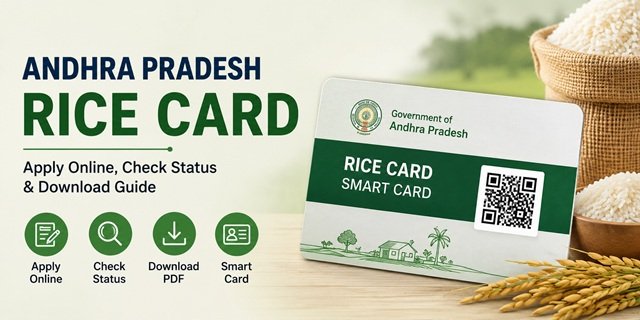
In Andhra Pradesh, a ration card is officially called a Rice Card. This is not just a naming difference. The Rice Card reflects the state’s primary commodity entitlement, which is rice distributed free of cost at Fair Price Shops under the National Food Security Act. As of August 2025, the state has over 1.46 crore active Rice Cards covering approximately 4.3 crore family members across 29,795 Fair Price Shops.
Andhra Pradesh has introduced a major upgrade in 2025: the Smart Rice Card. These new ATM-style cards carry a QR code that stores complete household data, including FPS details, ration availability, and family member information. Unlike older cards that displayed photographs, the Smart Rice Card shows only names. Existing beneficiaries do not need to apply again. They collect the Smart Card directly from their nearest Fair Price Shop. New applicants apply through the channels described in this guide.
All Rice Card services are managed by the Department of Consumer Affairs, Food and Civil Supplies, Government of Andhra Pradesh. The four key platforms are: MeeSeva portal (ap.meeseva.gov.in) for new applications and modifications, AePDS portal (aepos.ap.gov.in) for RC details, beneficiary search, and eKYC status, EPDS portal (epdsap.ap.gov.in) for ration card lists and reports, and Civil Supplies Department (civilsupplies.ap.gov.in) for official notifications.
For a national overview of the NFSA framework and One Nation One Ration Card scheme, read our Ration Card India guide.
The Grama and Ward Sachivalayam System
Andhra Pradesh operates a unique last-mile delivery system called the Grama Sachivalayam (Village Secretariat) and Ward Sachivalayam system through the GSWS department. Every village and urban ward in the state has a designated secretariat staffed by Digital Assistants and Village Volunteers. All Rice Card services, including new applications, member additions, address corrections, card splits, and eKYC updates, are processed at these secretariats. This means citizens in AP rarely need to travel to a district office. Their village or ward-level secretariat handles almost everything. This door-step governance model is unique in the country at this scale.
Card Types Issued in Andhra Pradesh
Priority Household (PHH) Rice Card
For households identified under NFSA 2013 whose annual income is below Rs 10,000 in rural areas and Rs 12,000 in urban areas. The family must not own more than 3 acres of wetland or 10 acres of dryland. Monthly electricity consumption must be below 300 units. PHH cardholders receive 5 kg of rice per member per month under NFSA. In AP, rice is the primary entitlement and is distributed free of cost.
Antyodaya Anna Yojana (AAY) Rice Card
For households in the most severe deprivation, including households with no income, widows living alone, terminally ill persons, and tribal groups. Each AAY household receives 35 kg of rice per month free of cost, regardless of family size. The AAY category carries the highest food entitlement in the state.
Non-Priority Household (NPHH) Card
For households above the income threshold for NFSA categories. NPHH cardholders do not receive subsidised food grains but use the card as proof of identity, address, and income category for accessing pensions, scholarships, housing schemes, and other welfare programmes.
Eligibility Conditions
- Must be a permanent resident of Andhra Pradesh. Married couples where one spouse is a domiciliary of the state are also eligible.
- Annual family income must be below Rs 10,000 for rural households and Rs 12,000 for urban households for NFSA categories.
- The family must not own more than 3 acres of wetland agricultural land or 10 acres of dryland.
- Monthly household electricity consumption must remain below 300 units.
- No existing valid Rice Card should be held by any member of the household anywhere in India.
- AP residents currently living in other states can complete eKYC through OTP without visiting the village secretariat in person.
Documents Required
- Aadhaar card of all family members (mandatory for eKYC and biometric authentication)
- Mobile number linked to Aadhaar for OTP verification
- Proof of residence in Andhra Pradesh (electricity bill, water bill, or voter ID)
- Income certificate from an authorised government officer
- Caste certificate (if applicable for SC/ST priority identification)
- Land holding certificate (to verify the 3-acre wetland/10-acre dryland limit)
- Electricity consumption certificate or recent electricity bill
- For newly married couples: proof of marriage is not required for card splitting as per the updated 2025 guidelines
- Surrender certificate from the previous state or address if migrating
Applying Online via MeeSeva Citizen Portal
Step 1: Visit ap.meeseva.gov.in and click on Citizen Portal. If you are a first-time user, click on New Registration, create your account with your name, mobile number, and Aadhaar details, and log in. Existing users log in directly.
Step 2: After logging in, search for “Issue of New Ration Card” or navigate to Civil Supplies services and select the Rice Card application.
Step 3: Fill in the complete application form with all household member details, Aadhaar numbers, address, income details, land holding information, and electricity consumption data.
Step 4: Upload scanned copies of all required documents in PDF or JPEG format, each under 300 KB.
Step 5: Submit the application and save the Application Reference Number displayed on screen.
Step 6: The application is routed to the designated Digital Assistant at your Grama or Ward Sachivalayam for field verification. On successful verification, the Rice Card is issued and linked to your nearest Fair Price Shop within 15 to 30 working days.
Applying Through the Village or Ward Secretariat
Step 1: Visit your nearest Grama Sachivalayam (rural) or Ward Sachivalayam (urban). Every village and ward in AP has one.
Step 2: Meet the Digital Assistant at the secretariat and ask for the Rice Card application form. The form is also available for download at ap.meeseva.gov.in.
Step 3: Fill in the form with all household details and attach self-attested copies of all required documents.
Step 4: The Digital Assistant will enter your application into the GSWS system, complete Aadhaar verification on-site, and provide you with an acknowledgement number.
Step 5: Field verification is conducted and the Rice Card is issued after approval. You can also apply through any MeeSeva centre. Your Village Volunteer can guide you to the nearest one.
Collecting Your Smart Rice Card
Existing Rice Card holders do not need to apply again for the Smart Card. The new ATM-style Smart Rice Card with QR code is distributed directly at Fair Price Shops. Visit your designated FPS and collect your Smart Card. The QR code on the card stores your household data, FPS details, and ration entitlement information and is scanned at the ePoS machine during each transaction.
New applicants who receive their Rice Card after the Smart Card rollout will be issued the new QR-coded card directly. The Smart Card displays only the names of family members and the head of household without photographs.
Checking RC Status and Beneficiary Details
Step 1: Visit the AePDS portal at aepos.ap.gov.in.
Step 2: On the homepage, go to Reports, then MIS section, and click on “Ration Card/Rice Card Search”.
Step 3: Enter your Rice Card number (RC No.) in the field provided and press Enter.
Step 4: Your card status will be displayed. If the RC Status field shows “Active”, your card is valid for collecting ration at the FPS. The page also shows the names of all family members listed on the card, the assigned FPS, and eKYC completion status for each member.
Downloading the Rice Card PDF
Via EPDS AP Portal:
Visit epdsap.ap.gov.in/epdsAP/epds. On the homepage, click on “Print Ration Card” in the last column of the navigation menu. Enter your Rice Card number and verify to download or print the card.
Via DigiLocker:
Log in to digilocker.gov.in, search for the Department of Consumer Affairs, Food and Civil Supplies, Government of Andhra Pradesh, select Rice Card, and enter your card number to fetch and download the document.
Via Grama or Ward Secretariat:
Visit your nearest Grama or Ward Sachivalayam with your Aadhaar number or Rice Card number. The Digital Assistant can verify your eKYC and print a formal copy of your card on the spot.
Completing eKYC for Your Rice Card
eKYC is mandatory for all Rice Card holders in Andhra Pradesh. The AP government has instructed all beneficiaries to complete Aadhaar biometric eKYC immediately. Failure to complete eKYC may result in ration stoppage, inactive card status, or temporary suspension. Officials are also removing duplicate and ineligible beneficiaries through the verification process.
There are three ways to complete eKYC:
- At the Fair Price Shop: Visit your designated FPS and provide fingerprint biometric authentication on the ePoS machine. If fingerprint fails, try iris scanning. If both fail, facial authentication is available through the Village Volunteer.
- At MeeSeva Centre: Visit any MeeSeva centre with Aadhaar cards of all family members for eKYC completion.
- Online OTP-based eKYC (for out-of-state residents): AP residents living in other states can now complete eKYC through Aadhaar OTP without visiting the village secretariat in person. Log in to ap.meeseva.gov.in and use the eKYC option under Civil Supplies services.
Check your eKYC status for each family member at aepos.ap.gov.in under Beneficiary Details by entering your Rice Card number.
Checking Monthly Transaction History
To verify whether your monthly ration has been correctly issued and recorded:
Step 1: Go to aepos.ap.gov.in.
Step 2: Navigate to the Detailed Transactions or Abstract Transaction section.
Step 3: Enter your Rice Card number to see the exact quantity of rice, sugar, or dal allotted to you, the date and time of collection, and the FPS where the transaction was recorded. This allows you to cross-verify what you received against what the system recorded.
Making Modifications to the Rice Card
All modifications are processed at your nearest Grama or Ward Sachivalayam or through ap.meeseva.gov.in. Services available include:
- Addition of a new family member (newborn or newly married spouse)
- Deletion of a deceased or separated member
- Rice Card split for newly married couples (marriage certificate not required under 2025 guidelines)
- Address correction or change of Fair Price Shop
- Change of head of household
- Surrender of Rice Card for migrating families
Visit your secretariat, provide your Rice Card number and Aadhaar, and the Digital Assistant will process the modification. Tracking the status of the modification request is available on the MeeSeva portal using your acknowledgement number.
Raising a Complaint or Grievance
Through the Village or Ward Secretariat:
For any Rice Card issue, the first point of contact is your Grama or Ward Sachivalayam. The Digital Assistant and Village Volunteer can resolve most issues, including eKYC failures, ration discrepancies, and member update requests on the spot.
Online via Civil Supplies Portal:
Visit civilsupplies.ap.gov.in for official complaint submission and department notifications.
NFSA Grievance Portal:
Escalate unresolved complaints at the NFSA national grievance portal.
Helpline Numbers:
AP Civil Supplies Helpline: 1967 (toll-free)
AP EPDS Toll-Free: 1800-425-2977
Quick Reference Links
- New Application and Modifications: ap.meeseva.gov.in
- RC Details, Beneficiary Search, eKYC Status: aepos.ap.gov.in
- Ration Card List and Print: epdsap.ap.gov.in/epdsAP/epds
- Civil Supplies Department: civilsupplies.ap.gov.in
- NFSA Grievance Portal: nfsa.gov.in grievance portal
- DigiLocker: digilocker.gov.in
- Mera Ration App: Download on Google Play
- NFSA State Portals: nfsa.gov.in state portals
Frequently Asked Questions
Q. Why is it called a Rice Card instead of a ration card?
Andhra Pradesh officially names its PDS card a Rice Card because rice is the primary food grain distributed to eligible households. The state issues rice free of cost to PHH and AAY cardholders, making rice the defining entitlement. The Smart Rice Card, introduced in 2025, is the updated digital version with a QR code.
Q. What is the Smart Rice Card and how do I get it?
The Smart Rice Card is an ATM-style card with a QR code that replaces the older physical card. It stores complete household and FPS data. Existing beneficiaries collect it directly from their nearest Fair Price Shop at no cost. New applicants receive the Smart Card automatically after approval. No separate application is needed for the upgrade.
Q. What is the Grama Sachivalayam and why does it matter for Rice Card services?
Grama Sachivalayam is Andhra Pradesh’s village-level secretariat system under the GSWS department. Every village and urban ward has a secretariat staffed by Digital Assistants and Village Volunteers who can process all Rice Card services, including new applications, eKYC, member additions, card splits, and grievances at your doorstep. You rarely need to go to a district office.
Q. What is the income limit for an AP Rice Card?
Annual household income must be below Rs 10,000 for rural families and Rs 12,000 for urban families. Additionally, the family must not own more than 3 acres of wetland or 10 acres of dryland, and monthly electricity consumption must be under 300 units. All three criteria are verified during field verification.
Q. My fingerprint is not being recognised at the FPS. What do I do?
If fingerprint authentication fails at the ePoS machine, try iris scanning which is available at most Fair Price Shops. If both biometric options fail, facial authentication is available through the Village Volunteer. To permanently resolve the issue, visit your Grama or Ward Sachivalayam to update your biometric data at the Aadhaar centre.
Q. How do I check if my eKYC is complete?
Visit aepos.ap.gov.in and go to Beneficiary Details. Enter your Rice Card number to view the eKYC status of each family member. Members with incomplete eKYC will not be able to collect their ration entitlement at the FPS.
Q. Can I verify how much ration was issued to me last month?
Yes. Go to aepos.ap.gov.in and navigate to Detailed Transactions or Abstract Transactions. Enter your Rice Card number to view the exact quantity issued, date of transaction, and the FPS where it was recorded. This helps you verify any discrepancy between what you received and what the system shows.
Q. Can I use my AP Rice Card to collect rations in another state?
Yes. NFSA Rice Card holders in Andhra Pradesh are covered under the One Nation One Ration Card scheme. You can collect your food grain entitlement from any Fair Price Shop across India using your Aadhaar number for biometric authentication at the ePoS machine. No card transfer or new application is required.
Q. How is card splitting done for a newly married couple?
As per the 2025 updated guidelines, a marriage certificate is no longer required for Rice Card splitting in Andhra Pradesh. Visit your nearest Grama or Ward Sachivalayam with Aadhaar cards of both spouses and the existing Rice Card details. The Digital Assistant will process the split and issue a new card for the new household.
Q. I live outside Andhra Pradesh. Can I complete eKYC without returning?
Yes. AP residents living in other states can complete eKYC through Aadhaar OTP-based verification without visiting the village secretariat in person. Log in to ap.meeseva.gov.in and use the eKYC option under Civil Supplies services to complete verification remotely.
Q. What is the helpline for AP Rice Card complaints?
Call 1967 (toll-free) or 1800-425-2977 for AP Civil Supplies and Rice Card queries. For in-person resolution, visit your nearest Grama or Ward Sachivalayam. Online complaints can be submitted through civilsupplies.ap.gov.in.

Tabassum is a government document researcher and writer with over 5 years of experience exclusively dedicated to tracking and simplifying Central and State Government document processes across India. She has researched and published detailed guides on 100+ government documents and certificates – including Aadhaar Card, PAN Card, Ration Card, Domicile Certificate, and Birth Certificate – covering all states and the Central Government, helping lakhs of Indian citizens successfully complete their paperwork in simple, easy-to-understand language.