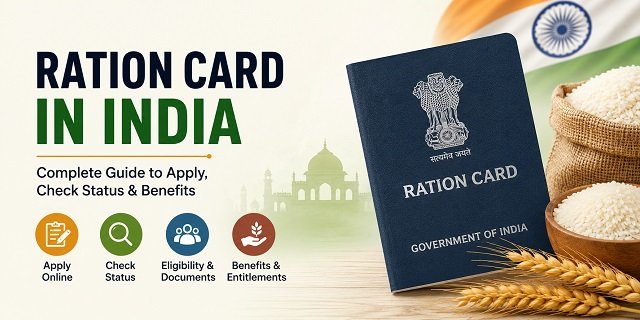
A ration card is one of the most important government documents for Indian households. It gives eligible families access to subsidised food grains every month through the Public Distribution System (PDS). Under the National Food Security Act (NFSA) 2013, state governments issue ration cards to households that meet the eligibility criteria, allowing them to buy rice, wheat, and coarse grains at heavily subsidised prices.
Beyond food access, a ration card also works as a widely accepted proof of identity and residence across India. This guide covers everything you need to know about ration cards in India, including types, eligibility, how to apply, how to check your status, and how to access your entitlements from any state using the One Nation One Ration Card (ONORC) scheme.
| Ration Card in India – Key Highlights | |
|---|---|
| Governing Law | National Food Security Act (NFSA), 2013 |
| Issued by | State Government Food and Civil Supplies Departments |
| Types of Cards | AAY (Antyodaya Anna Yojana), PHH (Priority Household), NPHH/APL |
| Entitlement (AAY) | 35 kg per household per month |
| Entitlement (PHH) | 5 kg per person per month |
| Current Price | Free of cost under PMGKAY (Pradhan Mantri Garib Kalyan Anna Yojana) |
| Application Mode | Online (State Portal), Offline (District Office), or through CSC |
| National Helpline | 1967 |
| ONORC Scheme | Available – collect ration from any FPS across India |
| Official Portal | https://nfsa.gov.in |
What is a Ration Card?
A ration card is an official document issued by state governments in India. It identifies households that qualify for subsidised food grains under NFSA and allows them to purchase these essentials from Fair Price Shops (FPS), popularly known as ration shops.
The Department of Food and Public Distribution under the Ministry of Consumer Affairs, Food and Public Distribution, oversees the overall framework, while each state government manages its own Public Distribution System, determines eligibility, and issues cards accordingly.
Types of Ration Cards in India
Under the National Food Security Act 2013, there are two primary categories of ration cards:
1. Antyodaya Anna Yojana (AAY) Ration Card
This card is meant for the poorest of the poor households. It targets families with no stable income, landless agricultural workers, daily wage earners, homeless individuals, elderly persons with no support, and widows without a regular income source.
Each AAY household receives 35 kg of food grains per month, regardless of family size. Under the Pradhan Mantri Garib Kalyan Anna Yojana, food grains are currently provided free of cost to all NFSA beneficiaries, including AAY cardholders. The earlier NFSA subsidised prices were rice at Rs 3 per kg, wheat at Rs 2 per kg, and coarse grains at Rs 1 per kg.
2. Priority Household (PHH) Ration Card
This card is issued to households that meet the economic criteria set by their respective state government. It covers low-income families, SC/ST households, urban poor living in slums, landless labourers, and others who need food support but do not fall in the poorest category.
PHH cardholders receive 5 kg of food grains per person per month at the same subsidised rates as AAY.
3. Non-Priority Household (NPHH) or APL Ration Card
Some states also issue cards to households above the poverty line for identity purposes or limited benefits. These are not covered under NFSA entitlements but are still valid identity documents.
Who is Eligible for a Ration Card?
Eligibility is determined by the state government under NFSA guidelines. Generally, the following criteria apply:
- The applicant must be an Indian citizen and a permanent resident of the state where they are applying.
- The household should not already hold a ration card.
- The family income must fall within the limits set by the respective state.
- Applicants must not be income tax payers, hold large agricultural land, own a four-wheeler, or have any member in a regular government job (criteria vary by state).
- The eldest woman in the family is typically the head of the ration card. In the absence of an adult woman, the eldest male member may apply.
Documents Required for Ration Card Application
The exact document requirements vary by state and the type of ration card being requested. Commonly requested documents include:
- Aadhaar card of family members.
- Proof of residence.
- A recent passport-size photograph of the applicant.
- Mobile number for communication and verification.
- Existing ration card or surrender certificate, where applicable.
- Supporting documents for member addition, deletion, or correction requests.
How to Apply for a Ration Card
Since ration cards are issued by state governments, the application process varies across states. There are three main ways to apply:
Method 1: Apply Through the State PDS Portal (Online)
Step 1: Visit https://nfsa.gov.in/portal/ration_card_state_portals_aa to access the list of all state and UT food portals.
Step 2: Click on your state to be redirected to the official state food department portal.
Step 3: Look for the option to apply for a new ration card or download the application form.
Step 4: Fill in all the required details, including family member information, income details, and residential address.
Step 5: Upload scanned copies of the required documents.
Step 6: Submit the application and note down the reference or acknowledgement number for future tracking.
Method 2: Apply Offline Through the District Food Office
Step 1: Visit your nearest District Food and Civil Supplies Office or Tehsil Office.
Step 2: Collect the ration card application form (Rural or Urban, as applicable).
Step 3: Fill in the form clearly with all family details and attach self-attested photocopies of the required documents.
Step 4: Submit the form at the designated counter and collect the receipt.
Step 5: The concerned official will verify your application and documents on the ground.
Step 6: If approved, your name will appear in the ration card beneficiary list within 30 days.
Method 3: Apply Through a Common Service Centre (CSC)
If you are not comfortable using the internet, you can visit your nearest Common Service Centre (CSC) with your documents. The CSC operator will fill in and submit the application on your behalf. A nominal service charge may apply.
How to Check Ration Card Status Online
Step 1: Go to https://nfsa.gov.in/public/nfsadashboard/publicrcdashboard.aspx to view the national ration card dashboard.
Step 2: You can also visit your state’s official PDS portal directly from https://nfsa.gov.in/portal/ration_card_state_portals_aa.
Step 3: Select your state and then navigate to the ration card search or status section.
Step 4: Enter your ration card number, Aadhaar number, or the name of the head of the household.
Step 5: The portal will display your current card status, family members listed, entitlements, and FPS details.
How to Check Your Ration Card Details on NFSA Portal
You can view your own ration card details directly on the NFSA portal:
Step 1: Visit https://nfsa.gov.in/public/frmPublicGetMyRCDetails.aspx
Step 2: Enter your ration card number or Aadhaar number.
Step 3: The system will display your registered card details, including the category (AAY or PHH), family members, and monthly entitlement.
How to Download a Digital Ration Card
Most state governments now allow beneficiaries to view and download their ration card details online through the state food and civil supplies department portal. The steps vary by state, but the general process is as follows.
Step 1: Visit your state’s official food and civil supplies portal (links provided in the state-wise section below).
Step 2: Look for options such as Ration Card Details, Beneficiary Search, or Download Ration Card on the homepage.
Step 3: Enter the required details – ration card number, Aadhaar number, or registered mobile number, as asked.
Step 4: Your ration card details will appear on screen. Where available, click the Download or Print option to save the PDF.
Note: In states where a PDF download is not available, beneficiaries can take a screenshot of the displayed details or request a printed copy from the nearest Fair Price Shop or food department office. Online records are accepted as valid for verification under the ONORC scheme.
How to Add a Family Member to a Ration Card
A new family member can be added to an existing ration card when there is a change in the household, such as the birth of a child, marriage, adoption, or inclusion of a dependent relative. Most states allow this request online through the state food portal or offline through the local food and civil supplies office or authorised service centre.
Documents generally required for member addition:
- Existing ration card (original or number).
- Aadhaar card of the new member to be added.
- Birth certificate (for newborn addition).
- Marriage certificate (for addition of spouse after marriage).
- Deletion proof from the previous ration card (if the member was on another card).
- Relationship proof with the head of the family.
After verification, the food department updates the household record.
Beneficiaries should check the updated beneficiary list online to confirm
successful addition before visiting the Fair Price Shop.
How to Remove a Family Member from a Ration Card
A family member must be removed from a ration card when they have married into a different household, migrated permanently, received a separate ration card, or passed away. Keeping records updated prevents duplication in government databases and avoids issues during e-KYC verification.
Documents generally required for member deletion:
- Existing ration card.
- Death certificate (for deceased member removal).
- Marriage certificate (for removal after marriage).
- New ration card or proof of separate enrolment (if applicable).
- Written application or deletion request form as prescribed by the state.
One Nation One Ration Card (ONORC) Scheme
The One Nation One Ration Card (ONORC) scheme allows any NFSA beneficiary to collect their entitled food grains from any Fair Price Shop anywhere in India, not just in their home state or district. This is especially beneficial for migrant workers and daily wage labourers who frequently relocate for employment.
The scheme uses Aadhaar-based biometric authentication at electronic Point of Sale (ePoS) machines installed at FPS shops. A family member remaining at the home address can continue to claim their share, while the migrant member can avail their entitlement at the destination location.
To track your portability transactions and find the nearest FPS in any city, you can use the Mera Ration 2.0 App, developed by the National Informatics Centre, Government of India. The app is available on the Google Play Store and Apple App Store. Its key features include:
- View the ration card and entitlement details
- Check the monthly transaction history
- Find the nearest Fair Price Shop
- File and track grievances
Aadhaar Seeding for Ration Card
Aadhaar seeding is mandatory for all ration card family members under NFSA. Every member listed on the ration card must have their Aadhaar number linked to it. This enables biometric authentication at FPS shops, which helps prevent ghost cards and ensures benefits reach genuine beneficiaries.
e-KYC verification is also required periodically. If Aadhaar seeding is not done, family members may face difficulty collecting their entitlements at the Fair Price Shop. To link Aadhaar with your ration card, visit your state food portal or your district Food and Civil Supplies office.
How to File a Grievance for Ration Card Issues
If you face any issue related to your ration card or PDS entitlements, you can register a grievance through the following channels:
Online Grievance on NFSA Portal:
Visit https://nfsa.gov.in/public/frmRegisterPublicGrievance.aspx and fill in your ration card number, FPS details, and description of the problem.
State-wise Grievance Portals:
You can also access your state’s online grievance system from https://nfsa.gov.in/portal/State_UT_Online_Grievance_AA.
Toll-Free Helpline:
Call the national helpline number 1967 for NFSA-related complaints. Many states also have their own dedicated helpline numbers.
State-wise Ration Card Portals
Since ration cards are issued by state governments, each state has its own portal and process. You can access the complete list of all state and UT food portals at:
https://nfsa.gov.in/portal/ration_card_state_portals_aa
Individual state articles with step-by-step guides are available on sarkariguide.in for all 28 states and 8 union territories. Each state guide covers the exact online and offline process, state-specific documents, eligibility criteria, and the official portal link for that state.
State-wise Ration Card Application Process
Although the National Food Security Act provides the overall framework, ration cards are issued and managed by individual state governments. The application process, required documents, online portals, beneficiary categories, and correction procedures differ from state to state. Applicants should always follow the procedure prescribed by their respective state food and civil supplies department.
Select your state from the list below to access the complete ration card guide for your state, covering online application, status check, beneficiary list, member addition, correction, Aadhaar seeding, and grievance procedures.
Frequently Asked Questions (FAQs)
Q1. Can I apply for a ration card online from anywhere in India?
Most states now allow online applications through their official food portals. You can access all state portal links from the NFSA website. For states where online applications are not available, you can apply through a CSC or visit the district food office.
Q2. How long does it take to get a new ration card?
Once the application is submitted and verified, the name typically appears in the beneficiary list within 30 days. This can vary by state and category. AAY applications may take longer due to additional income verification requirements.
Q3. Can I use my ration card in a different state?
Yes. Under the One Nation One Ration Card (ONORC) scheme, you can collect your entitled food grains from any Fair Price Shop across the country using Aadhaar-based authentication.
Q4. What if my name is missing from the ration card list?
First, check your application status on the state food portal. If the application was approved but your name is missing, contact the District Supply Officer or file a grievance online at the NFSA portal.
Q5. Is Aadhaar mandatory for a ration card?
Yes. Aadhaar seeding is mandatory for all family members listed on an NFSA ration card. e-KYC using Aadhaar is required for collecting food grains at FPS shops through biometric authentication.
Q6. Can I add a new family member to my existing ration card?
Yes. You can apply to add a new member such as a newborn, newly married spouse, or dependent parent by submitting the relevant documents at your district food office or through the state food portal.
Q7. What is the difference between an AAY and a PHH ration card?
An AAY card is for the poorest households and provides 35 kg of food grains per month per household. A PHH card is for low-income households under NFSA and provides 5 kg per person per month. Subsidised rates are the same for both.
Q8. What is the Mera Ration App and who should use it?
The Mera Ration App is a government app developed by the National Informatics Centre. It helps NFSA beneficiaries check their ration card details, monthly entitlements, transaction history, find nearby FPS shops, and file grievances. It is especially useful for migrant workers using the ONORC scheme.
Q9. Can a family hold more than one ration card?
No. Each household is allowed only one ration card. Holding a duplicate ration card is illegal. If you already have a ration card in one state and move to another, you must surrender the old card before applying for a new one.
Q10. How do I file a complaint if I am not receiving my full grain entitlement at the FPS?
You can register a grievance at https://nfsa.gov.in/public/frmRegisterPublicGrievance.aspx or call the national helpline 1967. You can also escalate the complaint to your state food department’s grievance portal.
Q11. What documents are needed to add a newborn to the ration card?
Typically, you need the birth certificate of the child, the existing ration card, and a filled application form for member addition. Submit these at the district food office or through your state portal.
Q12. Can I download my ration card digitally?
Many states now provide the option to download a digital copy of your ration card through their state food portal or through the DigiLocker app. Check your state’s official portal for this facility.
Q13. What is PMGKAY and how does it affect my ration card
entitlement?
Under Pradhan Mantri Garib Kalyan Anna Yojana (PMGKAY), the Central Government provides food grains free of cost to all NFSA beneficiaries – both AAY and PHH cardholders – instead of the earlier subsidised prices. This benefit has been extended and is available through your existing NFSA ration card at your assigned Fair Price Shop.
Q14. What is e-KYC and is it mandatory for my ration card?
e-KYC is the electronic verification of a beneficiary’s identity using Aadhaar biometric or OTP authentication. It is mandatory for all NFSA beneficiaries. If e-KYC is not completed, you may face difficulty collecting your monthly entitlement at the Fair Price Shop. Visit your state food portal or district food office to complete it.
Q15. Can I surrender my ration card if I no longer need it?
Yes. If your household no longer qualifies for NFSA benefits, you can voluntarily surrender your ration card at the district food office. A surrender certificate is issued, which is required if any family member wants to be included in another household’s ration card.

Tabassum is a government document researcher and writer with over 5 years of experience exclusively dedicated to tracking and simplifying Central and State Government document processes across India. She has researched and published detailed guides on 100+ government documents and certificates – including Aadhaar Card, PAN Card, Ration Card, Domicile Certificate, and Birth Certificate – covering all states and the Central Government, helping lakhs of Indian citizens successfully complete their paperwork in simple, easy-to-understand language.