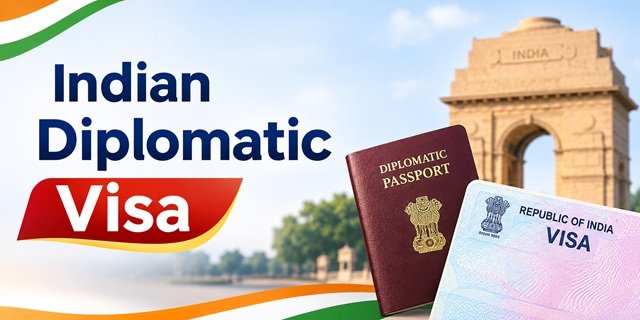
An Indian Diplomatic Visa is a special visa category for foreign diplomats, United Nations diplomats and their eligible dependent family members who are assigned to India or visiting the country for diplomatic purposes. It is intended for individuals travelling on official diplomatic assignments rather than ordinary tourism, business or personal visits.
Under India’s revised visa framework announced by the Ministry of Home Affairs in August 2026, Diplomatic Visa is one of the nine main visa categories. The category covers diplomats, including UN diplomats assigned to India or visiting India, and their dependents. The application process is handled through the designated government system under the Ministry of External Affairs (MEA).
In this guide, you will learn who can apply for an Indian Diplomatic Visa, which documents are required, how to submit an application, whether diplomatic passport holders need a visa, applicable fees, validity, visa-free entry arrangements and the difference between Diplomatic and Official Visas.
Indian Diplomatic Visa Overview |
|
|---|---|
| Visa Name | Indian Diplomatic Visa |
| Visa Category | Diplomatic Visa |
| Introduced / Revised Framework | Revised visa framework announced in 2026 |
| Responsible Ministry | Ministry of Home Affairs and Ministry of External Affairs |
| Eligible Applicants | Foreign diplomats, UN diplomats and eligible dependents |
| Main Purpose | Diplomatic assignments and official diplomatic visits to India |
| Passport Type | Diplomatic passport, subject to applicable rules and arrangements |
| Application Mode | Online through the designated government application system |
| Visa Fee | Depends on applicable rules, nationality and bilateral arrangements |
| Visa Validity | As granted by the competent Indian authority |
| Official Application Portal | MEA Diplomatic/Official Visa Portal |
What Is an Indian Diplomatic Visa?
An Indian Diplomatic Visa is a special visa issued to eligible foreign diplomats and their dependent family members for diplomatic assignments or visits to India. It facilitates the entry and stay of foreign representatives who are travelling in connection with diplomatic relations, government-to-government engagements or recognised international diplomatic responsibilities.
The category also covers diplomats of the United Nations who are assigned to India or visiting the country, along with their eligible dependents.
Unlike an ordinary Indian visa, a Diplomatic Visa is linked to the applicant’s diplomatic status and the official purpose of travel. It is not intended for ordinary tourists, private visitors or foreign nationals travelling to India for routine commercial activities.
The Ministry of Home Affairs announced a revised Indian visa framework on 11 November 2026, confirming that the number of main visa categories had been reduced from 13 to 9. Diplomatic Visa is one of these nine categories.
Who Is Eligible for an Indian Diplomatic Visa?
Eligibility for an Indian Diplomatic Visa depends on the applicant’s diplomatic status, official assignment and the purpose of travel. The revised visa framework specifically identifies diplomats, UN diplomats and their dependents as eligible groups.
The following applicants may fall under this category, subject to the applicable government requirements:
1. Foreign Diplomats Assigned to India
Foreign nationals holding diplomatic status and assigned to India may apply for a Diplomatic Visa. This may include diplomats posted to foreign embassies, high commissions or eligible diplomatic missions in India.
The applicant’s assignment and diplomatic status must be supported by the appropriate official communication from the sending government or diplomatic authority.
2. Diplomats Visiting India
Foreign diplomats visiting India for an official diplomatic purpose may also qualify. Such visits may include diplomatic consultations, official meetings, bilateral discussions or other recognised diplomatic engagements.
The nature and duration of the proposed visit must be supported by the relevant official documentation.
3. United Nations Diplomats
Diplomats associated with the United Nations who are assigned to India or visiting India are specifically included in the revised Diplomatic Visa category.
The applicant may be required to provide an official communication from the relevant United Nations authority or organisation confirming the assignment or visit.
4. Dependent Family Members of Diplomats
Eligible dependent family members of foreign diplomats may also qualify for a Diplomatic Visa. This provision may cover the spouse and other recognised dependents of the principal diplomat, subject to applicable eligibility conditions.
Dependent applicants must provide supporting documents establishing their relationship with the principal diplomat. Their visa arrangements may also depend on the principal applicant’s assignment and visa status.
5. Dependents of UN Diplomats
Eligible dependent family members of United Nations diplomats assigned to or visiting India may also be considered under the Diplomatic Visa category.
The relevant organisation’s documentation and proof of relationship may be required during the application process.
Important: Merely working for a foreign government, embassy or international organisation does not automatically make someone eligible for a Diplomatic Visa. The applicant must fall within the applicable diplomatic classification. Non-diplomatic government officials are covered separately under the Official Visa category.
Documents Required for an Indian Diplomatic Visa
Applicants must submit documents supporting their identity, diplomatic status, official assignment and purpose of travel. The exact checklist may vary according to the applicant’s circumstances and the instructions issued by the Ministry of External Affairs or the concerned Indian authority.
The commonly required documents may include:
| Document | Purpose |
|---|---|
| Valid Diplomatic Passport | To establish the applicant’s identity and diplomatic passport status. |
| Online Visa Application | Completed application submitted through the designated government portal. |
| Note Verbale | Official communication from the Ministry of Foreign Affairs, diplomatic mission or relevant authority supporting the visa request. |
| Official Assignment or Visit Details | Information about the diplomatic posting, official visit, purpose and proposed duration of stay. |
| Passport Photograph | Recent photograph meeting the applicable government specifications. |
| Dependent Relationship Proof | Marriage certificate, birth certificate or other accepted evidence for dependent applicants. |
| Principal Diplomat’s Details | Passport, visa or assignment details of the diplomat with whom the dependent is associated. |
| Additional Supporting Documents | Any other documents requested by the competent authority during processing. |
What Is a Note Verbale?
A Note Verbale is a formal written communication exchanged between diplomatic missions, foreign ministries and government authorities. It is commonly used in diplomatic and consular matters.
For a Diplomatic Visa application, the Note Verbale generally supports the applicant’s official status, purpose of travel, proposed assignment or visit and other relevant details.
It is an important supporting document because a Diplomatic Visa is granted on the basis of the applicant’s recognised diplomatic capacity rather than an ordinary personal travel purpose.
Documents for Dependent Family Members
Dependents applying with or in connection with a diplomat may need to provide:
- Valid passport.
- Completed online application.
- Recent passport-size photograph.
- Copy of the principal diplomat’s passport and relevant visa or assignment details, as applicable.
- Marriage certificate for a spouse.
- Birth certificate for a child.
- Official communication or Note Verbale covering the dependent, where required.
- Any additional document requested by the competent authority.
Applicants should follow the latest document checklist displayed on the official portal. The list above is a general guide and should not be treated as a substitute for the authority’s case-specific requirements.
How to Apply for an Indian Diplomatic Visa?
The Ministry of External Affairs has a dedicated online system for Diplomatic and Official Visa services. According to the MEA’s published instructions, eligible foreign nationals holding diplomatic, official or service passports are required to submit their applications online. Physical visa application forms are not accepted through this process.
Follow these general steps to apply:
Step 1: Obtain Official Documentation
Before starting the application, the applicant should coordinate with the relevant foreign ministry, diplomatic mission, United Nations office or other competent organisation to obtain the required Note Verbale and supporting assignment documents.
Dependent applicants should also arrange the required relationship proof and the principal diplomat’s relevant details.
Step 2: Open the Official MEA Application Portal
Visit the dedicated MEA Diplomatic/Official Visa Portal.
Use the application facility applicable to the applicant’s category. Applicants should carefully read the instructions displayed on the portal before proceeding.
Step 3: Complete the Online Application
Enter the required personal, passport, diplomatic assignment and travel information. Ensure that the details match the applicant’s passport and official supporting documents.
Any incorrect information or mismatch between the application and supporting documents may lead to queries or delays during processing.
Step 4: Upload the Required Documents
Upload the documents requested by the portal, which may include:
- Passport details and relevant passport pages.
- Recent photograph.
- Note Verbale or official request.
- Assignment or visit-related documents.
- Dependent relationship documents, where applicable.
- Other supporting documents requested by the authority.
Ensure that scanned documents and photographs meet the prescribed file format, size and quality requirements.
Step 5: Submit the Application
Review the application carefully before submitting it. Verify the passport number, nationality, personal information, proposed period of stay and purpose of travel.
After submission, retain the application reference or acknowledgement details for future communication and status-related enquiries.
Step 6: Wait for Verification and Processing
The application will be examined by the competent authority. Additional documents or clarifications may be requested if necessary.
Applicants should regularly check their registered email address and mobile number for application-related communications.
Step 7: Receive the Visa Approval
Once the application is approved, the applicant will receive an intimation through the communication method specified by the MEA system.
The MEA’s published online procedure states that diplomatic and official visa services are issued electronically through the designated system. Applicants should follow the latest instructions regarding the visa document and any passport submission requirement communicated by the authority.
Note: The Ministry of Home Affairs announced in November 2026 that IT systems were being updated to implement the revised visa framework. Therefore, applicants should follow the category and instructions currently displayed on the official portal rather than relying solely on older application screenshots or visa codes.
Indian Diplomatic Visa Fees
There is no single universal fee that can safely be quoted for every Indian Diplomatic Visa applicant. The applicable fee or exemption may depend on the applicant’s nationality, diplomatic passport category, bilateral agreements and the instructions of the competent Indian authority.
Some Indian diplomatic missions publish gratis (no-fee) arrangements for Diplomatic and Official Visa services. However, such an exemption should not be assumed to apply to every nationality or application.
Applicants should check the current fee information on the relevant official government portal or confirm the applicable arrangement through the concerned Indian Mission before submitting the application.
Indian Diplomatic Visa Validity and Duration of Stay
The validity of an Indian Diplomatic Visa is determined by the competent authority according to the applicant’s diplomatic assignment, official visit, nationality and applicable arrangements.
There is no single validity period that applies to every Diplomatic Visa applicant. The permitted duration of stay may vary between a short-term diplomatic visit and a longer assignment in India.
Applicants should carefully check the following details after the visa is granted:
- Visa validity and permitted period of stay.
- Number of permitted entries.
- Any restrictions or special conditions.
- Whether the visa is linked to a specific diplomatic assignment.
- Conditions applicable to dependent family members.
The applicant must comply with the conditions stated in the visa approval and applicable Indian immigration rules.
Visa-Free Entry to India for Diplomatic Passport Holders
Not every foreign diplomatic passport holder needs to obtain an Indian Diplomatic Visa before travelling to India. India has entered into visa-exemption agreements with several countries for holders of diplomatic passports and, in certain cases, official or service passports.
These agreements allow eligible passport holders to enter, transit or stay in India without obtaining a separate visa, subject to the conditions of the relevant agreement.
However, visa-free entry is not automatically available to every diplomatic passport holder. The applicable agreement may specify:
- Whether the exemption applies to diplomatic passports only or also to official/service passports.
- The maximum permitted period of visa-free stay.
- Whether the exemption applies to short visits or diplomatic assignments.
- Whether family members are included.
- Any prior approval or other entry conditions.
Examples of India’s Diplomatic Passport Visa Exemptions
The Ministry of External Affairs publishes separate lists of countries with operational visa-exemption agreements for diplomatic passports and for diplomatic, official or service passports.
For example, the MEA’s published list includes the following arrangements for diplomatic passport holders:
| Country | Passport Category | Published Visa-Free Stay |
|---|---|---|
| Afghanistan | Diplomatic Passport | 30 days |
| Armenia | Diplomatic Passport | 90 days |
| Austria | Diplomatic Passport | 90 days |
| Botswana | Diplomatic Passport | 90 days |
These are examples from the MEA’s published diplomatic passport exemption list. The applicable agreement and its current operational status should always be checked before travel. The table should not be interpreted as a complete list of visa-exempt countries.
Important: Some countries have separate agreements covering diplomatic and official/service passports, while others have agreements covering diplomatic passports only. The passport category and the exact terms of the agreement matter.
Diplomatic Visa for Dependents and Family Members
The revised Indian visa framework expressly includes dependents of diplomats and UN diplomats within the Diplomatic Visa category. This allows eligible family members to accompany or join the principal diplomat in India, subject to the applicable requirements.
Dependent applicants may include the spouse and other recognised dependent family members. The applicant may be required to submit relationship proof and supporting details of the principal diplomat.
Some important points for dependent applicants are:
- Dependent status must be established through acceptable documents.
- The principal diplomat’s assignment or visa details may be required.
- The dependent’s visa validity may be linked to the principal diplomat’s assignment or permitted stay.
- Each dependent may need to complete a separate application, as directed by the portal.
- Visa approval is subject to the competent authority’s decision.
Being a family member of a diplomat does not automatically guarantee a visa. The applicant must meet the applicable dependent eligibility requirements and complete the required formalities.
Diplomatic Visa Extension, Conversion and Transfer in India
Diplomatic and Official Visa holders may require visa-related services after entering India, particularly when an assignment is extended, a visa category needs to be changed or an existing visa needs to be transferred.
The Ministry of External Affairs lists the following services under its dedicated Diplomatic/Official Visa online system:
- Visa Extension: For eligible applicants who need to extend their permitted stay in India.
- Visa Conversion: For eligible cases where a change in visa category is permitted by the competent authority.
- Visa Transfer: For eligible applicants who need to transfer their visa-related details under the applicable procedure.
The MEA advises applicants to submit their applications at least three weeks before the expiry of their existing visa or visa-free period.
Applicants should not wait until the last date to initiate an extension or other visa-related service. Approval depends on the competent authority and the applicable rules.
For these services, use the official MEA Diplomatic/Official Visa Portal and follow the current instructions.
Indian Diplomatic Visa vs Indian Official Visa
Diplomatic Visa and Official Visa are two separate categories under India’s revised visa framework. Both are intended for people travelling to India in an official capacity, but they cover different types of applicants.
The Diplomatic Visa category is intended for diplomats, including UN diplomats, and their eligible dependents. The Official Visa category is intended for non-diplomatic government officials, including non-diplomatic UN officials, and their dependents.
| Basis | Diplomatic Visa | Official Visa |
|---|---|---|
| Main Applicants | Foreign diplomats | Non-diplomatic government officials |
| UN Personnel | UN diplomats | Non-diplomatic UN officials |
| Purpose | Diplomatic assignment or visit | Official government assignment or visit |
| Dependents | Eligible dependents of diplomats | Eligible dependents of non-diplomatic officials |
| Passport Category | Generally associated with diplomatic passports | May involve official or service passports, as applicable |
| Application System | Dedicated MEA online system | Dedicated MEA online system |
Although the two categories have separate eligibility conditions, the MEA provides a common online system for Diplomatic and Official Visa services. Applicants must select the appropriate category according to their actual official status.
For more information, read our upcoming guide on Indian Official Visa, which will explain eligibility, documents and the application procedure for non-diplomatic officials.
Important Rules for Indian Diplomatic Visa Applicants
Applicants should keep the following points in mind before applying for or travelling to India on a Diplomatic Visa:
- A Diplomatic Visa is intended for eligible diplomats and their recognised dependents, not ordinary tourists or private visitors.
- Diplomatic status and the official purpose of travel should be supported by appropriate documents.
- A Note Verbale or official request may be required as part of the application.
- Diplomatic passport holders should check whether a visa-exemption agreement applies to their nationality and proposed visit.
- Visa-free entry is subject to the exact terms of the applicable bilateral agreement.
- Visa validity and permitted stay must be checked from the actual approval or applicable exemption conditions.
- Applicants seeking an extension or other visa service should apply sufficiently in advance.
- Dependents must provide the required relationship proof and follow the applicable application procedure.
- Applicants should use official government portals and avoid unauthorised agents claiming guaranteed or expedited approval.
Official Websites and Important Links
Applicants should use official government websites for the latest application instructions, document requirements, visa exemptions and other services.
| Official Website / Service | Purpose |
|---|---|
| Ministry of Home Affairs Foreigners Division | Immigration and visa policy information. |
| MEA Diplomatic/Official Visa | Official information about Diplomatic and Official Visa services. |
| MEA Diplomatic/Official Visa Portal | Online application, extension, conversion and transfer services. |
| MEA Diplomatic Passport Visa Exemptions | Countries with operational visa-exemption agreements for diplomatic passport holders only. |
| MEA Diplomatic and Official/Service Passport Exemptions | Countries with operational visa-exemption agreements for diplomatic and official/service passport holders. |
| PIB Revised Indian Visa Framework 2026 | Government announcement about the nine main visa categories. |
| Indian Visa Online | General Indian visa application information. |
Conclusion
The Indian Diplomatic Visa is an important part of India’s visa framework for foreign diplomats, UN diplomats and their eligible dependent family members. It facilitates diplomatic assignments and official visits while providing a separate immigration route from ordinary visitor and business travel.
Applicants should confirm their eligibility, arrange the required official documentation and submit their applications through the designated Ministry of External Affairs system. They should also check whether a visa-exemption agreement applies to their nationality before travelling to India.
Since India’s visa framework is undergoing implementation updates following the 2026 rationalisation, applicants should always rely on the latest instructions published by the competent government authority rather than outdated visa categories or application procedures.
Frequently Asked Questions (FAQs)
Ans. An Indian Diplomatic Visa is a special visa category for eligible foreign diplomats, UN diplomats and their dependent family members who are assigned to India or visiting the country for diplomatic purposes.
Ans. Foreign diplomats, eligible United Nations diplomats and their recognised dependent family members may apply, subject to the applicable eligibility conditions and government approval.
Ans. Yes. The Ministry of Home Affairs included Diplomatic Visa among the nine main categories in the revised Indian visa framework announced in 2026.
Ans. Not automatically. The applicant must qualify as a diplomat under the applicable classification. Non-diplomatic government officials are generally covered under the separate Official Visa category.
Ans. UN diplomats assigned to India or visiting India may fall under the Diplomatic Visa category. Non-diplomatic UN officials are covered separately under the Official Visa category.
Ans. Eligible dependent family members may qualify for a Diplomatic Visa. They may need to provide relationship proof and the principal diplomat’s relevant assignment or visa details.
Ans. Not in every case. India has visa-exemption agreements with certain countries for diplomatic passport holders. The exemption depends on nationality, passport category, permitted stay and the terms of the applicable agreement.
Ans. Some diplomatic visa arrangements may be gratis, but a universal fee exemption cannot be assumed. The applicable fee or exemption depends on nationality, bilateral arrangements and the concerned authority’s instructions.
Ans. There is no single validity period for all applicants. The validity and permitted stay depend on the diplomatic assignment, purpose of travel and conditions approved by the competent authority.
Ans. A Note Verbale or equivalent official request is an important supporting document in diplomatic visa applications. Applicants should follow the document checklist provided by the designated government portal.
Ans. Eligible applicants should use the dedicated MEA Diplomatic/Official Visa application system at indianfrro.gov.in/mea and follow the instructions for the relevant application category.
Ans. Eligible applicants may apply for an extension through the designated MEA online system. The request should be submitted before the existing visa or visa-free stay expires.
Ans. The MEA lists visa conversion as one of the services available through its Diplomatic/Official Visa system. However, conversion is subject to eligibility, applicable rules and approval by the competent authority.
Ans. The MEA advises applicants to apply at least three weeks before the expiry of their existing visa or visa-free period.
Ans. A Diplomatic Visa is intended for diplomats and eligible dependents, whereas an Official Visa is intended for non-diplomatic government officials, including non-diplomatic UN officials, and their eligible dependents.
Ans. Applicants should check the Ministry of External Affairs’ Diplomatic/Official Visa page, the dedicated MEA application portal and the Ministry of Home Affairs’ official updates for the latest requirements.

Tabassum is a government document researcher and writer with over 5 years of experience exclusively dedicated to tracking and simplifying Central and State Government document processes across India. She has researched and published detailed guides on 100+ government documents and certificates – including Aadhaar Card, PAN Card, Ration Card, Domicile Certificate, and Birth Certificate – covering all states and the Central Government, helping lakhs of Indian citizens successfully complete their paperwork in simple, easy-to-understand language.