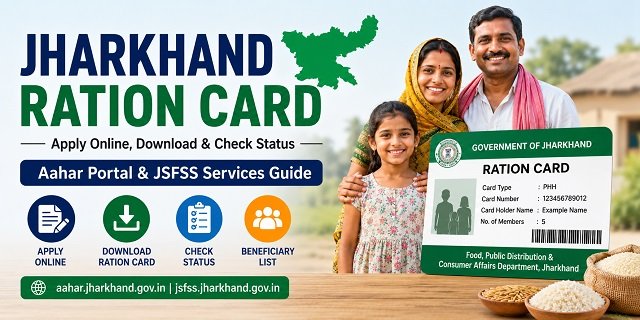
The Department of Food, Public Distribution and Consumer Affairs, Government of Jharkhand, runs its ration card system through two separate portals with clearly divided roles. The Aahar Jharkhand portal (aahar.jharkhand.gov.in) is where you check the beneficiary list, download your Ration Card, view monthly eligibility, and track dealer-wise distribution. The JSFSS portal (jsfss.jharkhand.gov.in) handles new applications, corrections, and status tracking. Using the wrong portal for a task is the most common confusion among Jharkhand applicants, which is why both platforms are explained separately in this guide.
Jharkhand has a feature that sets it distinctly apart from every other state covered in this series: the Green Card. Issued under the Jharkhand State Food Security Scheme (JSFSS), the Green Card covers families who fall below the poverty line but could not be included in the central NFSA beneficiary list due to the allocation ceiling set by the Government of India. The state funds these benefits entirely from its own budget.
Alongside this, Jharkhand’s AAY cardholders receive food grains at just Re 1 per kg, one of the most heavily subsidised rates in any state. The state also has a large tribal and Scheduled Tribe population with dedicated PDS safeguards, and JharSewa-issued documents, such as income and caste certificates, are directly accepted during ration card applications to reduce rejections.
For a national overview of the NFSA framework and the One Nation One Ration Card scheme, read our Ration Card India Guide.
Four Card Types Explained
Antyodaya Anna Yojana (AAY)
For the most economically distressed households with no fixed income. Landless agricultural labourers, construction workers with no regular employment, widows without income, disabled persons as the sole earning member, destitute elderly persons, and primitive tribal groups qualify under this category. Each AAY household in Jharkhand receives 35 kg of food grains per month at Re 1 per kg, regardless of family size. This is one of the lowest PDS rates in the country.
Priority Household (PHH)
For households below the poverty line identified under NFSA 2013. PHH cardholders receive 5 kg of food grains per member per month at subsidised rates. The state prioritises ST/SC households, construction labourers, and families with no landholding or only marginal landholding under this category.
Green Card (JSFSS)
The Green Card is unique to Jharkhand. It is issued under the Jharkhand State Food Security Scheme to families who are genuinely poor but were excluded from the central NFSA list because Jharkhand had reached its NFSA coverage ceiling. Green Card holders receive subsidised food grains funded entirely by the Jharkhand state government. Applications for the Green Card go through the JSFSS portal at jsfss.jharkhand.gov.in, and the Aahar portal has a dedicated SECC Cardholders section for tracking Green Card allocations dealer-wise.
Above Poverty Line (APL)
For households above the state-defined income threshold. APL cardholders do not receive subsidised food grains under NFSA or JSFSS but hold the card as a valid proof of identity and residence for accessing government services, banking, and educational institutions across Jharkhand.
The Role of SECC Data in Jharkhand PDS
Jharkhand uses the Socio-Economic and Caste Census (SECC) 2011 data extensively to identify beneficiaries for NFSA and JSFSS coverage. The Aahar portal has a dedicated SECC Cardholders section under the Beneficiary Card Details menu, where you can view Green Card allocations dealer-wise using SECC data. This transparency helps tribal and rural households verify their inclusion and track their entitlements without visiting any office.
JharSewa Documents and Ration Card Applications
JharSewa (jharsewa.jharkhand.gov.in) is Jharkhand’s citizen services portal for obtaining official certificates, including income, caste, residential, and other documents. These JharSewa-issued certificates are directly accepted during ration card applications on the JSFSS portal. Applicants who already have their income and caste certificates from JharSewa face significantly fewer rejections than those who submit general documents. If you do not have these certificates yet, apply at JharSewa before starting your Ration Card application.
Who Can Apply for a Ration Card in Jharkhand
- Must be a permanent resident of Jharkhand with verifiable address proof in the state.
- No member of the household should currently hold a ration card anywhere in India.
- Annual household income must fall within the limits set for the respective category.
- ST/SC households, landless labourers, migrant workers returning to Jharkhand, and primitive tribal groups receive priority during inclusion drives.
- Households excluded from the NFSA list due to the central coverage ceiling can apply specifically for the Green Card under JSFSS.
- Newly married couples without any existing card coverage can register as a fresh household unit.
Documents Required
- Aadhaar Card of all family members (mandatory for eKYC linkage)
- Proof of residence in Jharkhand (electricity bill, water bill, or voter ID with Jharkhand address)
- Income certificate from JharSewa or a Circle Officer (preferred for lower rejection rates)
- Caste certificate from JharSewa (especially for ST/ SC applicants)
- Passport-sized photographs of the head of the family
- Mobile number linked to Aadhaar Card
- Bank account details for Aadhaar-seeded account
- Land possession certificate (if landholding is being declared as nil or marginal)
- Surrender certificate from previous state or address (if applicable)
Registering and Applying for a New Ration Card
Step 1: Go to aahar.jharkhand.gov.in. On the homepage, look for “Register to Apply for Ration Card” (राशनकार्ड आवेदन के लिए पंजीकरण करें). Click on it.
Step 2: You will be taken to the Ration Card Management System (RCMS) registration page. Enter the name of the head of the family, mobile number, Aadhaar number, and other basic details. Click Submit to register.
Step 3: After registration, log in using your registered mobile number and OTP. Navigate to the new application section and select whether you are applying for an NFSA card (PHH or AAY) or a Green Card under JSFSS.
Step 4: For NFSA applications, complete and submit the form online. For Green Card (JSFSS) applications, the detailed process is on the JSFSS portal. Go to that portal, click on “Register to Apply for Ration Card” under the Green Card section, and fill in the complete family details.
Step 5: Fill in all household details, including family members, Aadhaar numbers, income, caste, and land holding information. Upload all required documents, including JharSewa-issued certificates.
Step 6: Submit the application and note down the Acknowledgement Number. Take a printout of the filled application along with the documents and submit it to your nearest Block Supply Officer (BSO) or District Supply Officer (DSO) office. Collect the official receipt from the BSO/DSO at submission.
Step 7: The BSO will examine your application and documents. On successful verification, the card is issued and linked to your nearest Fair Price Shop within 15 to 30 working days.
Checking Application Status
Step 1: Visit aahar.jharkhand.gov.in and click on “Check Ration Card Application Status” (राशन कार्ड आवेदन की स्थिति जांचें) on the homepage.
Step 2: Enter your Acknowledgement Number or Ration Card Number in the field provided.
Step 3: Your current application status will be displayed, showing whether the application is under review, verified, approved, or rejected. If rejected, the reason for rejection will also be visible.
You can also check the status through the Jharkhand State Food Commission portal (jharkhandsfc.in) under the PDS Entitlement section.
Viewing the Monthly Eligibility List
Jharkhand has a dedicated monthly eligibility list that shows which cardholders are entitled to collect rations in a given month. This is separate from the general beneficiary list and is updated every month:
Step 1: Go to aahar.jharkhand.gov.in and click on “Beneficiary Card Details” (लाभुक के कार्ड की जानकारी) in the navigation menu.
Step 2: Click on “Eligibility List Monthly” (पात्रता सूचि मासिक).
Step 3: Select your District, Block, Panchayat or Ward, Village, and Dealer name in sequence.
Step 4: The monthly eligibility list for your dealer will appear, showing all cardholders scheduled to receive a ration that month. Verify your name and card details are correctly listed.
Checking the Full Beneficiary List
Step 1: Visit aahar.jharkhand.gov.in and navigate to the RCMS Report section.
Step 2: Select your District, Block, Village or Ward, and Dealer from the sequential dropdowns.
Step 3: Choose the type of card (AAY, PHH, Green Card, or APL) from the Type of Card dropdown.
Step 4: Click Submit. The complete list of ration card holders under your selected dealer appears with card numbers, names, card types, family count, Aadhaar-linked member count, and mapped status.
Step 5: Click on any ration card number to view all individual member details. Note your ration card number for use during the download process.
Downloading the Ration Card PDF
Step 1: Go to aahar.jharkhand.gov.in and navigate to the RCMS Report or Beneficiary Card Details section.
Step 2: Search for your ration card number by following the district, block, village, and dealer navigation path described above, or enter your ration card number directly if you already have it.
Step 3: Click on your card number to open the full ration card details page.
Step 4: Use the Print or Download option on the page to save your ration card as a PDF. This digital copy is your official ration card document for use at the Fair Price Shop and for government services.
You can also download the ration card through DigiLocker by searching for the Department of Food, Public Distribution and Consumer Affairs, Government of Jharkhand, and entering your ration card number.
Checking Green Card (JSFSS) Allocations
Green Card allocations are tracked separately from NFSA cards. To view Green Card dealer-wise allocation data, go to aahar.jharkhand.gov.in, click on Beneficiary Card Details, and select SECC Cardholders. Navigate to the dealer-wise allocation search page and enter your district, block, and dealer details to view Green Card holders and their monthly entitlement status.
How to Check Your Name in the Jharkhand Ration Card List
Checking your name in the Jharkhand Ration Card List helps you confirm whether your household is currently included under the Public Distribution System (PDS). If your name appears in the list, you can receive food grain benefits through your assigned Fair Price Shop. You can search the list online through the Aahar Jharkhand Portal by selecting your district, block, village, and ration dealer details.
How to Correct the Name in the Jharkhand Ration Card
If your name is misspelt or does not match your Aadhaar Card or other official documents, submit a correction request through the prescribed ration card modification process. Make sure the details entered in your application match your supporting documents exactly. Incorrect personal information can create problems during eKYC verification and ration distribution.
How to Change Address in Jharkhand Ration Card
If you move to a new location within Jharkhand, update the address linked to your Ration Card to ensure uninterrupted access to PDS benefits. Keep your residence proof ready before submitting the request. After verification, the department updates the address and maps the ration card to the appropriate Fair Price Shop.
Difference Between NFSA Card and Green Card in Jharkhand
Jharkhand operates both NFSA Ration Cards and Green Cards under separate beneficiary categories. NFSA cards are issued under the National Food Security Act, while Green Cards are provided through the Jharkhand State Food Security Scheme. Understanding the difference helps applicants choose the correct category and avoid delays during the application process.
Raising a Complaint or Grievance
Online via Jharkhand State Food Commission:
Visit jharkhandsfc.in and use the online grievance submission form. The Jharkhand State Food Commission is the statutory body overseeing PDS rights under NFSA. All complaints about denial of ration, FPS malpractice, or card-related issues can be escalated here.
NFSA Grievance Portal:
Escalate unresolved complaints at the NFSA national grievance portal.
Helpline Number:
Food Department Jharkhand: 18003456598 (toll-free)
National PDS Helpline: 1967
Offline:
Visit your Block Supply Officer or District Supply Officer office with a written complaint and your ration card details.
Quick Reference Links
- Aahar Portal (List, Download, Monthly Eligibility): aahar.jharkhand.gov.in
- JSFSS Portal (Apply, Modify, Status): jsfss.jharkhand.gov.in
- Jharkhand State Food Commission (Grievance): jharkhandsfc.in
- JharSewa (Income, Caste, Residential Certificates): jharsewa.jharkhand.gov.in
- NFSA Grievance Portal: nfsa.gov.in grievance portal
- DigiLocker: digilocker.gov.in
- Mera Ration App: Download on Google Play
- NFSA State Portals: nfsa.gov.in state portals
Frequently Asked Questions
Q. What is the Green Card in Jharkhand?
Ans. The Green Card is a ration card unique to Jharkhand, issued under the Jharkhand State Food Security Scheme (JSFSS). It targets families below the poverty line who were excluded from the NFSA beneficiary list because Jharkhand had reached its central NFSA coverage ceiling. The state funds these benefits from its own budget. Apply for the Green Card at jsfss.jharkhand.gov.in. Track allocations through the SECC Cardholders section on the Aahar portal.
Q. Which portal do I use for applying and which for downloading?
Ans. Use jsfss.jharkhand.gov.in for new applications, modifications, and status checks. Use aahar.jharkhand.gov.in for downloading the Ration Card, checking the beneficiary list, viewing monthly eligibility, and tracking dealer-wise distribution. This split-portal system is one of the most important things to understand before starting any ration card process in Jharkhand.
Q. What is the monthly eligibility list and how is it different from the beneficiary list?
Ans. The beneficiary list is the full permanent record of all NFSA and JSFSS ration card holders in the state. The monthly eligibility list shows which cardholders are specifically entitled to collect their ration during the current month. It is updated every month and helps you verify whether your entitlement has been correctly recorded for that particular month. Access it under Beneficiary Card Details on the Aahar portal.
Q. Why should I get my documents from JharSewa before applying?
Ans. JharSewa issues government-verified income, caste, and residential certificates for Jharkhand residents. These certificates are directly accepted and cross-verified by the JSFSS portal during ration card applications. Applications backed by JharSewa documents have significantly lower rejection rates. Obtain your certificates at jharsewa.jharkhand.gov.in before starting the application.
Q. What food grain rate do AAY cardholders get in Jharkhand?
Ans. AAY cardholders in Jharkhand receive 35 kg of food grains per household per month at Re 1 per kg. This is one of the lowest PDS rates offered by any state government in India and is part of Jharkhand’s commitment to food security for its most economically vulnerable households.
Q. What is the SECC Cardholders section on the Aahar portal?
Ans. SECC stands for Socio-Economic and Caste Census 2011. Jharkhand uses SECC data to identify JSFSS Green Card beneficiaries. The SECC Cardholders section on aahar.jharkhand.gov.in lets you check Green Card allocations by dealer to verify inclusion and track monthly entitlements for JSFSS beneficiaries separately from NFSA cardholders.
Q. Do I need to submit physical documents after applying online?
Ans. Yes. After filling and submitting your application online, you must take a printout of the filled form along with all supporting documents and physically submit them to your nearest Block Supply Officer (BSO) or District Supply Officer (DSO). Collect the official receipt at submission. The BSO then conducts field verification before the card is issued.
Q. Can I use my Jharkhand ration card to collect ration in another state?
Ans. Yes, for AAY and PHH NFSA cardholders. Jharkhand is part of the One Nation One Ration Card scheme, allowing you to collect your entitled food grains from any Fair Price Shop in India using Aadhaar biometric authentication. Green Card (JSFSS) holders are covered under the state scheme only and cannot use the ONORC portability outside Jharkhand.
Q. How do I add a newborn to the ration card?
Ans. Log in to jsfss.jharkhand.gov.in, navigate to the modification section, select member addition, enter the child’s Aadhaar number and birth details, upload the birth certificate, and submit. You can also visit your nearest BSO office with the birth certificate and your existing ration card to process the addition offline.
Q. What is the helpline number for Jharkhand ration card complaints?
Ans. Call 18003456598 (toll-free) for the Food Department Jharkhand. For national PDS grievances, call 1967. For statutory complaints under NFSA rights, visit jharkhandsfc.in and use the online grievance submission form of the Jharkhand State Food Commission.
Q. I am from a tribal community. Are there any special provisions for me?
Ans. Yes. Jharkhand has a significant Scheduled Tribe (ST) population and the PDS system gives priority to ST households during NFSA and JSFSS inclusion drives. Primitive tribal groups are specifically categorised under AAY and receive the maximum entitlement of 35 kg per household per month at Re 1 per kg. ST households are also exempt from certain income criteria during field verification. Carry your caste certificate from JharSewa when applying to benefit from these provisions.

Tabassum is a government document researcher and writer with over 5 years of experience exclusively dedicated to tracking and simplifying Central and State Government document processes across India. She has researched and published detailed guides on 100+ government documents and certificates – including Aadhaar Card, PAN Card, Ration Card, Domicile Certificate, and Birth Certificate – covering all states and the Central Government, helping lakhs of Indian citizens successfully complete their paperwork in simple, easy-to-understand language.