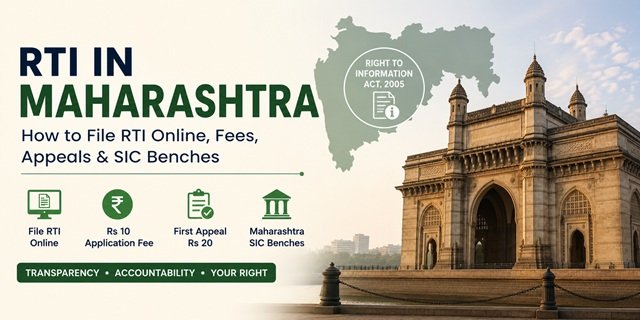
Maharashtra provides an official online RTI portal at rtionline.maharashtra.gov.in, where citizens can submit RTI applications and First Appeals for Maharashtra Government departments and public authorities. The portal, developed and maintained by the National Informatics Centre (NIC), is available in both English and Marathi. For technical assistance, applicants can contact the toll-free helpline 1800 120 8040 or email rti.support@maharashtra.gov.in.
Maharashtra follows a few RTI practices that are different from most states. The online application is limited to 150 words, making it one of the shortest RTI formats in the country. It also charges a Rs 20 fee for filing a First Appeal, whereas most states do not levy any appeal fee. In addition, applicants are free to submit RTI requests entirely in Marathi under the Maharashtra RTI Rules, without translating them into English.
Second Appeals and RTI complaints are handled by the Maharashtra State Information Commission (Rajya Mahiti Ayog) through its official portal at sic.maharashtra.gov.in. Besides its headquarters in Mumbai, the Commission functions through seven regional benches located at Greater Mumbai, Konkan (Navi Mumbai), Pune, Nashik, Chhatrapati Sambhaji Nagar, Amravati, and Nagpur, making it one of India’s largest state information commission networks. The current Chief Information Commissioner is Shri Rahul Bhalchandra Pande.
If you are comparing Maharashtra’s RTI process with other states or need information about filing RTIs with Central Government departments such as Railways, Income Tax, EPFO, Passport, or UIDAI, you can also refer to our detailed RTI Online India Guide.
Which RTI Portal Should You Use in Maharashtra?
Before filing an RTI, identify whether the information is held by the Maharashtra Government or the Central Government. Each has a separate Public Information Officer (PIO) and a separate RTI portal. If you submit your application to the wrong authority, it may be returned or transferred, resulting in unnecessary delay.
Use the Maharashtra RTI portal (rtionline.maharashtra.gov.in) for state government departments such as:
- Revenue Department – 7/12 (Satbara Utara), 8A extracts, mutation (Ferfar), land records, property records
- Maharashtra Police – FIR details, investigation status, departmental records and action taken reports
- Maharashtra State Electricity Distribution Company (MSEDCL) – electricity bills, new connections and service-related records
- Maharashtra Jeevan Pradhikaran (MJP) – drinking water supply and sewerage projects
- Public Works Department (PWD) – roads, bridges, government building projects and contracts
- Zilla Parishads, Panchayat Samitis and Gram Panchayats – village development works and rural schemes
- MHADA – housing schemes, lottery records and flat allotments
- MSRTC – bus services, depots and transport administration
- School Education, Higher & Technical Education and other state education departments
- CIDCO – New Mumbai development projects, plots and housing
- Urban Development Department, Town Planning and state government hospitals
- State welfare and pension schemes such as the Sanjay Gandhi Niradhar Anudan Yojana and the Shravanbal Seva State Pension Scheme
Use the Central RTI Portal (rtionline.gov.in) for Central Government organisations located in Maharashtra, including:
- Central Railway, Western Railway and Konkan Railway
- Income Tax Department
- Regional Passport Offices at Mumbai, Pune, Nagpur and Chhatrapati Sambhajinagar
- Employees’ Provident Fund Organisation (EPFO)
- UIDAI for Aadhaar Card-related information
- Reserve Bank of India (RBI) and Securities and Exchange Board of India (SEBI)
- Mumbai Port Authority
- Atomic Energy Regulatory Board (AERB)
Some Maharashtra Public Authorities Still Require Offline RTI
Although Maharashtra has an online RTI portal, not every public authority is integrated with it. Before starting an online application, check whether the department appears in the portal’s list. If it is unavailable, send your RTI application directly to the concerned PIO by Speed Post or submit it in person.
- Brihanmumbai Municipal Corporation (BMC)
- Pune Municipal Corporation
- Nagpur Municipal Corporation
- Nashik Municipal Corporation and several other municipal corporations
- CIDCO (verify portal availability before filing online)
- MHADA (verify portal availability before filing online)
RTI Fee and Payment Options in Maharashtra
Maharashtra follows the Maharashtra RTI Rules, 2012, for RTI fees and payment methods. Before filing your application, it is useful to know the applicable charges and the accepted payment options.
| Service | Fee |
|---|---|
| RTI Application | Rs 10 |
| First Appeal | Rs 20 |
| Second Appeal before Maharashtra SIC | No fee |
| Photocopies (A4/A3) | Rs 2 per page |
| Information on CD | Rs 50 per CD |
| Inspection of records | Free for the first hour, then Rs 5 for every 15 minutes (or part thereof) |
Maharashtra is one of the very few states that charges a Rs 20 fee for filing a First Appeal. In most other states, the First Appeal is filed free of cost.
The prescribed fee should be paid in favour of the Accounts Officer of the concerned department or public authority.
BPL applicants: Citizens holding a valid Below Poverty Line (BPL) certificate do not have to pay the Rs 10 application fee. However, the Rs 20 First Appeal fee is still payable. Attach a self-attested copy of the BPL certificate while submitting the application.
How Can You Pay the RTI Fee?
When filing online through rtionline.maharashtra.gov.in, the portal currently accepts only Internet Banking. Other payment methods such as UPI, debit cards and credit cards are not available on the Maharashtra RTI portal at present.
If you are submitting the application by post or in person, you can use any of the following payment methods:
- Indian Postal Order (IPO)
- Demand Draft (DD)
- Banker’s Cheque
- Money Order
- Court Fee Stamp of Rs 10 affixed to the application
- Cash (only when submitting the application personally at the PIO’s office, against an official receipt)
How to Write an RTI Within Maharashtra’s 150-Word Limit
Unlike many other states, the Maharashtra RTI portal allows only 150 words for the information request. This limit applies only to the questions you ask, not to your name, address, or contact details. Before submitting the application, keep your request short, clear, and focused on the records you actually need.
These simple tips will help you stay within the word limit:
- Ask only the most important questions. If you need information on several issues, file separate RTI applications instead of trying to cover everything in one request.
- Keep every question short. Write one point at a time and ask only for a specific document, record, report, or file.
- Skip unnecessary background. Avoid explaining your grievance or the history of the matter. Start directly with “Please provide…” or “Kindly furnish…”.
- Use exact details. Mention survey number, file number, project name, application number, date, or office name wherever possible. This helps the PIO locate the records faster.
Can You File an RTI in Marathi?
Yes. Under the Maharashtra RTI Rules, you can submit your RTI application entirely in Marathi. There is no requirement to translate it into English. Most district, tehsil, municipal and gram panchayat offices regularly process Marathi RTI applications and generally issue replies in Marathi as well.
If you are filing the application offline, you may also use the prescribed Marathi RTI application format. However, using the prescribed format is optional; a clearly written application on plain paper containing all the required details is generally accepted under the RTI Act.
How to File RTI Online in Maharashtra
You can submit an RTI application online through the official Maharashtra RTI portal at rtionline.maharashtra.gov.in. The process takes only a few minutes if you have your questions and payment method ready.
Step 1: Open the official portal
Visit rtionline.maharashtra.gov.in and choose either English or Marathi.
Step 2: Start a new RTI application
Click “Submit Request”. Read the instructions and continue. This portal is only for Maharashtra Government departments and public authorities. Do not use it for Central Government organisations such as Railways, EPFO, Passport Office or Income Tax.
Step 3: Select the department
Choose the Public Authority or Department from the available list. Make sure you select the correct office because your application will be sent there for processing.
Step 4: Fill in your details
Enter your name, postal address, mobile number and email ID. If you are claiming the BPL exemption, select the relevant option and upload your BPL certificate.
Step 5: Write your RTI request
Enter your questions in the application box. The portal allows a maximum of 150 words, so keep your questions short and specific. Ask only for records, documents, file notings or certified copies instead of explanations or opinions.
Step 6: Upload supporting documents (if required)
If your request relates to an earlier application, complaint or reference number, you may upload the relevant PDF for easier identification. This step is optional.
Step 7: Pay the application fee
If you are not a BPL applicant, pay the Rs 10 application fee through Internet Banking, which is currently the only online payment option available on the Maharashtra RTI portal.
Step 8: Submit and save your Registration Number
After successful payment, submit the application. The portal generates a Registration Number and also sends it to your registered email and mobile number. Keep this number safe because you will need it to track your application or file a First Appeal.
Step 9: Check your application status
Whenever you want to know the progress, open the “View Status” option on the portal and enter your Registration Number.
How to File the First Appeal Online
If you do not receive a reply within 30 days or you are not satisfied with the information provided, you can submit a First Appeal through the same portal.
Step 1: Visit rtionline.maharashtra.gov.in and click “Submit First Appeal”.
Step 2: Enter your RTI Registration Number and the email ID used while filing the original application.
Step 3: Clearly mention why you are filing the appeal—for example, no reply within 30 days or incomplete information.
Step 4: Pay the Rs 20 First Appeal fee through Internet Banking. Maharashtra is one of the few states that charges a fee for filing the First Appeal.
Step 5: Submit the appeal and save the acknowledgement number for future reference.
How to File RTI by Post in Maharashtra
If the department is not available on the online portal or you prefer the offline method, you can send your RTI application directly to the concerned Public Information Officer (PIO).
Step 1: Prepare your RTI application in English or Marathi and mention the information you require in clear, numbered points. Keep the request within the 150-word limit, followed by Maharashtra.
Step 2: Attach the Rs 10 application fee. You can pay through an Indian Postal Order (IPO), Demand Draft (DD), Banker’s Cheque, Court Fee Stamp or any other mode permitted under the Maharashtra RTI Rules. BPL applicants should attach a self-attested copy of their BPL certificate instead of the application fee.
Step 3: Before posting, keep a photocopy of the complete application and the payment proof for your records.
Step 4: Send the application to the concerned PIO by Speed Post with Acknowledgement Due (AD) or submit it personally at the office and collect a dated acknowledgement receipt. This acknowledgement will help you calculate the statutory response period if you need to file an appeal later.
How Long Does the Department Have to Reply?
After your RTI application reaches the Public Information Officer (PIO), the reply must be provided within the time limits prescribed under the RTI Act.
| Situation | Time Limit |
|---|---|
| Normal RTI application | 30 days |
| Information concerning life or liberty | 48 hours |
| Application transferred to another public authority | Transfer within 5 days; the response period is counted from the date the new PIO receives the application. |
| Third-party consultation under Section 11 | Up to 40 days, as permitted under the RTI Act |
| Additional copying fee required | The period between the fee intimation and your payment is excluded while calculating the response time. |
When Should You File the First Appeal?
You should file a First Appeal before the designated First Appellate Authority (FAA) if:
- The PIO does not provide any reply within 30 days.
- The information supplied is incomplete or incorrect.
- Your application is rejected without valid reasons.
- Only part of the requested information is provided.
The First Appeal should normally be filed within 30 days from the date you receive the PIO’s reply or from the date on which the reply was due.
Maharashtra is one of the few states that charges a First Appeal fee. A fee of Rs 20 is payable for every First Appeal. Once the appeal is filed, the First Appellate Authority should normally decide it within 30 days, which may be extended up to 45 days after recording reasons in writing.
How to File a Second Appeal in Maharashtra
If you are not satisfied with the First Appellate Authority’s decision or you do not receive any order within the prescribed time, you can file a Second Appeal before the Maharashtra State Information Commission within 90 days. No fee is charged for filing a Second Appeal.
Online filing (recommended)
Step 1: Visit the Maharashtra State Information Commission portal at sic.maharashtra.gov.in.
Step 2: Complete the online appeal form by entering the details of your RTI application and First Appeal.
Step 3: Upload the required supporting documents in PDF format.
Step 4: Submit the appeal and save the acknowledgement or registration number for future reference.
Offline filing
If you prefer the offline method, send your appeal to the Maharashtra State Information Commission bench that has jurisdiction over the concerned public authority.
Attach the following documents:
- Copy of the original RTI application
- Proof of payment of the RTI application fee
- PIO’s reply (if received)
- Copy of the First Appeal
- Proof of payment of the Rs 20 First Appeal fee
- FAA’s order (if received)
- A brief note explaining why you are filing the Second Appeal
How to File a Complaint Before the Information Commission
A Second Appeal and a Complaint are different remedies under the RTI Act.
File a Second Appeal when you have already filed a First Appeal but are still dissatisfied with the outcome.
File a Complaint under Section 18 when the RTI process itself has been obstructed, for example:
- The PIO refused to accept your RTI application.
- No Public Information Officer has been appointed.
- You were asked to pay an illegal fee.
- You were prevented from submitting your RTI application.
- You faced any other procedural violation under the RTI Act.
Online complaints can be submitted through siconlinecomplaint.mahaitgov.in.
Choose the Correct Maharashtra SIC Bench
Maharashtra has one of the largest Information Commission networks in India. Before filing your appeal or complaint, select the bench that has jurisdiction over the district where the concerned public authority is located.
| Bench | Location |
|---|---|
| Mumbai Headquarters | Mumbai |
| Greater Mumbai | Mumbai |
| Konkan | Navi Mumbai |
| Pune | Pune |
| Nashik | Nashik |
| Chhatrapati Sambhajinagar | Chhatrapati Sambhajinagar |
| Amravati | Amravati |
| Nagpur | Nagpur |
For the latest contact details, email addresses, cause lists and office addresses of all benches, visit the official Maharashtra State Information Commission website at sic.maharashtra.gov.in.
Tips for Filing RTI in Maharashtra
- Check Mahabhulekh before filing a land RTI: Land records such as 7/12 (Satbara), 8A extracts and other revenue records are available on Mahabhulekh. If the required document is already available online, you may not need to file an RTI.
- Not every local body is available on the RTI portal: Some municipal corporations and local authorities may not appear on the Maharashtra RTI portal. If you cannot find the concerned public authority online, submit your RTI application directly to its Public Information Officer (PIO) by post or in person.
- Use Marathi for local offices: RTI applications written in Marathi are fully valid. For district, tehsil, panchayat and municipal offices, filing in Marathi often makes communication easier and helps avoid unnecessary clarification.
- Choose the correct Information Commission bench: Maharashtra has regional benches of the State Information Commission. While filing a Second Appeal or Complaint, select the bench that has jurisdiction over the district where the concerned public authority is located.
- Keep the request short and specific: The Maharashtra RTI portal allows only 150 words in the application. Ask for records or documents instead of lengthy explanations, and file a separate RTI if you have multiple unrelated issues.
If your issue is not about obtaining information under the RTI Act but about delayed government services, pending complaints, poor public service, or lack of departmental action, you can register a grievance through the Maharashtra CM Helpline. RTI helps you obtain official records, while the CM Helpline helps escalate unresolved public grievances.
Quick Reference
| Particular | Details |
|---|---|
| Official RTI Portal | rtionline.maharashtra.gov.in |
| Submit RTI Application | Apply Online |
| First Appeal | File First Appeal |
| Track RTI Status | View Status |
| Portal Helpline | 1800 120 8040 (24×7) |
| Portal Email | rti.support@maharashtra.gov.in |
| Maharashtra State Information Commission | sic.maharashtra.gov.in |
| Online Second Appeal | File Second Appeal |
| Online Complaint | File Complaint |
| SIC Appeal Procedure | Download PDF |
| SIC Headquarters | 13th Floor, New Administrative Building, Mantralaya, Mumbai – 400032 |
| Phone | 022-22856078 |
| Chief Information Commissioner | Shri Rahul Bhalchandra Pande |
| RTI Application Fee | Rs 10 |
| First Appeal Fee | Rs 20 |
| Copying Charges | Rs 2 per page |
| Online Payment | Internet Banking |
| Offline Payment | IPO, DD, Banker’s Cheque, Court Fee Stamp or Cash (in person) |
| Application Limit | 150 words |
| Land Records | mahabhulekh.maharashtra.gov.in |
| Central RTI Portal | rtionline.gov.in |
| Maharashtra Government | maharashtra.gov.in |
Frequently Asked Questions
Q. Why do I have to pay Rs 20 for the First Appeal in Maharashtra?
Ans. Maharashtra is one of the few states where a First Appeal under Section 19(1) is not free. Under the Maharashtra RTI Rules, 2012, a fee of Rs 20 must be paid while filing the First Appeal. For online appeals on rtionline.maharashtra.gov.in, payment is made through Internet Banking. If you are filing by post, attach the prescribed fee using the accepted offline payment mode. Failure to pay the fee may result in your appeal being returned or rejected.
Q. Why does Maharashtra allow only 150 words in an RTI application?
Ans. The Maharashtra RTI Rules, 2012 restrict the application text to 150 words. The limit applies only to the information requested and does not include your name, address or contact details. If you have several unrelated queries, it is better to file separate RTI applications instead of exceeding the word limit.
Q. Can I submit my RTI application in Marathi?
Ans. Yes. Marathi is a valid language for filing RTI applications in Maharashtra. You may write the entire application in Marathi, and the Public Information Officer (PIO) cannot insist on an English translation. Replies are generally provided in Marathi when the application is submitted in Marathi.
Q. What is the role of the Nodal Officer in Maharashtra’s online RTI portal?
Ans. When you submit an RTI application through rtionline.maharashtra.gov.in, it first reaches the department’s Nodal Officer. The Nodal Officer forwards it to the concerned PIO for processing. You can track the application status online using your Registration Number throughout this process.
Q. Can I file an RTI for BMC through the Maharashtra RTI portal?
Ans. No. The Brihanmumbai Municipal Corporation (BMC) and some other municipal corporations are not integrated with the Maharashtra RTI portal. In such cases, submit your RTI application directly to the concerned PIO of that municipal corporation by post or in person after checking its official website for the latest RTI contact details.
Q. Which Maharashtra Information Commission bench should I choose for a Second Appeal?
Ans. File your Second Appeal before the bench that has jurisdiction over the district where the concerned public authority is located. Maharashtra has regional benches at Mumbai, Greater Mumbai, Konkan, Pune, Nashik, Chhatrapati Sambhaji Nagar, Amravati and Nagpur. You can also file a Second Appeal online through the Maharashtra State Information Commission portal.
Q. Do I need to file an RTI to obtain a 7/12 (Satbara) extract?
Ans. Not usually. Most current 7/12 (Satbara) and other land records can be downloaded from the official Mahabhulekh portal. An RTI is generally required only if you need records that are unavailable online, historical documents, or certified copies for legal purposes.
Q. When should I file a Complaint instead of a Second Appeal?
Ans. File a Second Appeal when you are dissatisfied with the decision of the First Appellate Authority or when no order is passed within the prescribed time. File a Complaint under Section 18 when the PIO refuses to accept your RTI application, demands an incorrect fee, refuses access without accepting the application, or there is another procedural violation under the RTI Act. Maharashtra provides a separate online Complaint portal at siconlinecomplaint.mahaitgov.in, while Second Appeals are filed through the SIC portal.

Tabassum is a government document researcher and writer with over 5 years of experience exclusively dedicated to tracking and simplifying Central and State Government document processes across India. She has researched and published detailed guides on 100+ government documents and certificates – including Aadhaar Card, PAN Card, Ration Card, Domicile Certificate, and Birth Certificate – covering all states and the Central Government, helping lakhs of Indian citizens successfully complete their paperwork in simple, easy-to-understand language.