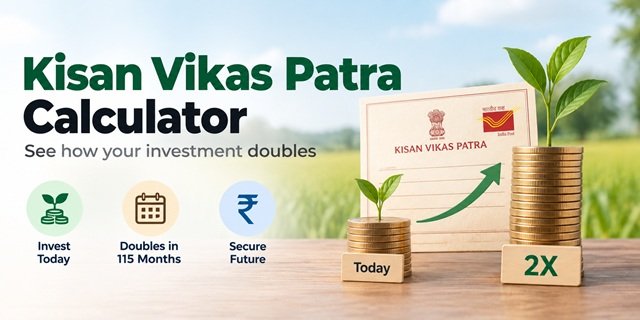
Use this calculator to see exactly when your Kisan Vikas Patra Scheme investment doubles. Enter your investment amount to see the maturity value, the exact doubling period of 115 months, and when your lock-in period ends.
| Year | Opening Balance | Interest Earned | Closing Balance |
|---|
This calculator assumes annual compounding at 7.5% for 9 full years, plus the remaining 7 months to complete the 115-month term, matching the scheme’s stated doubling period. Actual maturity value may vary slightly if the government revises the rate for future quarters, since your certificate locks in the rate applicable on your date of purchase.
What Is Kisan Vikas Patra?
Kisan Vikas Patra, or KVP, is a savings certificate offered by India Post. Despite its name suggesting it is only for farmers, anyone can invest in it. The scheme has one simple promise: your money doubles in a fixed number of months, currently 115 months, or 9 years and 7 months. You invest once as a lump sum, and the certificate grows on its own until maturity.
The Doubling Concept – What It Actually Means
KVP is often called the “money doubling scheme” because its entire design is built around one number: how many months it takes for your investment to become exactly double. At the current rate of 7.5% per annum, compounded annually, this takes 115 months. If the government changes the interest rate in a future quarter, the doubling period changes too, but only for certificates bought after that revision – your existing certificate keeps the rate and doubling period that applied on the day you invested.
How This Calculator Works
Enter the amount you want to invest. The interest rate and maturity period are fixed by the scheme, so you do not need to set them. The calculator shows your total investment, the interest you will earn, and the maturity value at 115 months, which should be close to double your original amount. Click the button to see how the balance grows year by year until it reaches maturity.
KVP Rules You Should Know
The minimum investment is Rs 1,000, in multiples of Rs 100, and there is no maximum limit. PAN Card is mandatory for investments of Rs 50,000 or more, and income proof is required for investments of Rs 10 lakh or more. KVP has a lock-in period of 30 months (2 years and 6 months) – during this period, you cannot withdraw your money except in the case of the certificate holder’s death, forfeiture by a Gazetted Officer, or a court order. After the 30-month lock-in ends, you can encash the certificate early, though you will receive a reduced return compared to holding it to full maturity.
KVP does not qualify for a Section 80C tax deduction, unlike PPF or NSC. The interest you earn is fully taxable at your income tax slab rate, though there is no TDS deducted at the time of payout. You can also use your KVP certificate as collateral to secure a loan from a bank.
KVP vs NSC – A Quick Comparison
| Feature | KVP | NSC |
|---|---|---|
| Current Interest Rate | 7.5% p.a. | 7.7% p.a. |
| Tenure | 115 months (9 years 7 months) | Fixed 5 years |
| Section 80C Benefit | Not available | Available up to Rs 1.5 lakh |
| Lock-in Before Withdrawal | 30 months | 5 years (except special cases) |
| Best Suited For | Long-term lump sum goals without needing a tax deduction | Medium-term goals with a tax-saving requirement |
Choose KVP if you have a lump sum you do not need for close to a decade and are not looking for a tax deduction. Choose NSC if you want a shorter 5-year lock-in along with the Section 80C benefit.
Frequently Asked Questions (FAQs)
Ans. At the current interest rate of 7.5% per annum, a Kisan Vikas Patra investment doubles in 115 months, which is equal to 9 years and 7 months. The doubling period applicable on the date of purchase remains fixed for the entire tenure, even if the government revises KVP rates for new investors in future quarters.
Ans. Kisan Vikas Patra currently offers an interest rate of 7.5% per annum, compounded annually. The Government of India reviews small savings scheme rates every quarter, but once a KVP certificate is purchased, the applicable interest rate remains unchanged until maturity.
Ans. Premature encashment is generally not allowed during the first 30 months (2 years and 6 months). Early withdrawal is permitted only in specific situations such as the death of the certificate holder, forfeiture by a Gazetted Officer, or a court order. After the lock-in period ends, the certificate can be encashed as per the applicable KVP rules.
Ans. No. Investments made in Kisan Vikas Patra do not qualify for deduction under Section 80C of the Income Tax Act. In addition, the interest earned on KVP is taxable according to the investor’s applicable income tax slab. However, no TDS is deducted on the maturity amount.
Ans. The minimum investment amount is ₹1,000, and additional investments can be made in multiples of ₹100. There is no upper investment limit. PAN is required for investments of ₹50,000 or more, while proof of income may be required for large investments as per applicable regulations.
Ans. No. Despite its name, Kisan Vikas Patra is not restricted to farmers. Any eligible resident Indian individual can invest in the scheme. KVP certificates can also be purchased jointly or on behalf of a minor by a parent or guardian.
Ans. Yes. Kisan Vikas Patra certificates can be pledged as collateral to obtain loans from banks and certain financial institutions. Since the investment serves as security, lenders may offer more favorable loan terms compared to unsecured borrowing.
Ans. The choice depends on your financial goals. NSC currently offers a 5-year tenure along with Section 80C tax benefits, making it suitable for investors seeking tax savings. KVP has a longer maturity period of 115 months and focuses on capital growth without providing tax deductions. Investors should choose the option that best matches their investment horizon and tax planning requirements.

Tabassum is a government document researcher and writer with over 5 years of experience exclusively dedicated to tracking and simplifying Central and State Government document processes across India. She has researched and published detailed guides on 100+ government documents and certificates – including Aadhaar Card, PAN Card, Ration Card, Domicile Certificate, and Birth Certificate – covering all states and the Central Government, helping lakhs of Indian citizens successfully complete their paperwork in simple, easy-to-understand language.