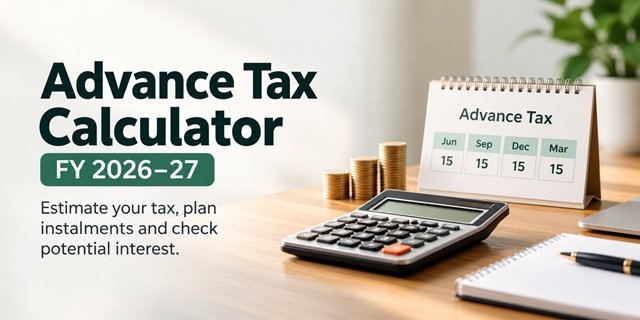
Advance tax may apply when your estimated tax payable for the year reaches ₹10,000 or more after eligible tax credits and TDS or TCS. Use this calculator to estimate your instalment schedule and possible interest on delayed or insufficient payments for Tax Year 2026–27. Your actual liability depends on your tax return and the applicable law.
Estimate your advance tax instalments and possible interest under the Income-tax Act, 2025.
Enter the estimated tax after computing your income, deductions and applicable tax credits, but before subtracting TDS or TCS in the next field. Include applicable surcharge and cess in your estimate.
Include eligible TDS or TCS credit relevant to this tax liability. Do not enter advance tax payments here.
Select Yes only if all the stated conditions apply. Other senior citizens may still need to pay advance tax.
Choose Yes only if your presumptive income falls within the categories covered by the applicable provision. Eligible taxpayers can generally pay the full advance tax by 15 March.
For each date, enter the total advance tax paid cumulatively up to that date. For example, the September figure should include payments made by June and September. Do not add the earlier payment again yourself.
The month field is a manual estimate for planning. The actual Section 424 period depends on the dates of tax payment and income determination or assessment. The law can count a part of a month as a month.
| Due date and provision | Required cumulative amount | Paid by date | Shortfall | Estimated interest |
|---|
This calculator is an estimate and does not replace a tax computation or assessment. It uses your entered figures and does not automatically account for special income, statutory exceptions, tax credits, amendments, bank holidays, revised estimates, or every case-specific rule.
Why Advance Tax Matters
Advance tax helps taxpayers pay estimated tax during the tax year instead of paying the entire amount later. It can apply to freelancers, professionals, business owners, investors and salaried individuals whose TDS does not cover their full tax liability.
Under Section 404 of the Income-tax Act, 2025, advance tax generally applies when the advance tax payable is ₹10,000 or more. The applicable provisions and exceptions should be checked for your individual circumstances.
Advance Tax Instalment Schedule for Tax Year 2026–27
| Due date | Cumulative percentage | What it means |
|---|---|---|
| 15 June | At least 15% | Total advance tax paid should reach at least 15% of the estimated advance tax liability. |
| 15 September | At least 45% | Total payments should reach at least 45%, including the amount already paid in June. |
| 15 December | At least 75% | Total payments should reach at least 75% of the estimated advance tax liability. |
| 15 March | 100% | The full advance tax liability should generally be paid by this date. |
These percentages are cumulative, not additional. For example, the September target is 45% in total, not another 45% on top of the June payment.
Presumptive Taxation
Eligible taxpayers covered by Section 58(2) of the Income-tax Act, 2025 can generally pay their entire advance tax liability in one instalment on or before 15 March. Eligibility depends on the applicable statutory category, so do not select this option merely because you operate a small business or work as a professional.
Section 424 and Section 425: What Is the Difference?
Section 424 deals with interest for defaults in payment of advance tax. In general, interest can apply at 1% for every month or part of a month when the relevant statutory conditions are met, including when advance tax paid is less than 90% of assessed tax.
Section 425 deals with interest for deferment of advance tax instalments. Under the applicable table, the June, September and December instalments use a 3% interest amount on the specified shortfall, while the March instalment uses 1%. The law also provides relief when payments by 15 June reach at least 12%, or payments by 15 September reach at least 36%, of the tax due on returned income. Special provisions and exceptions can change the result in an individual case.
Senior Citizen Exemption
A resident individual aged 60 or above who has no income chargeable under the head profits and gains of business or profession is generally not liable to pay advance tax. The exemption does not automatically apply to every senior citizen. If the conditions are not met, the normal advance tax rules may apply.
Official Sources
Frequently Asked Questions
Ans. Generally, a taxpayer whose advance tax payable for the year is ₹10,000 or more must pay advance tax, subject to statutory exceptions. TDS or TCS and other eligible tax credits affect the amount payable.
Ans. The usual instalment dates are 15 June, 15 September, 15 December and 15 March. The cumulative payment targets are 15%, 45%, 75% and 100%, respectively.
Ans. Eligible taxpayers under the applicable presumptive taxation provision can generally pay the full amount by 15 March. Other taxpayers are usually required to follow the instalment schedule, and a late payment may still attract interest.
Ans. No. The general exemption applies to a resident individual aged 60 or above who has no income chargeable under the head profits and gains of business or profession. Other senior citizens may remain liable.
Ans. Section 424 covers interest for defaults in payment of advance tax, including the applicable year-end shortfall test. Section 425 covers interest for deferment of individual advance tax instalments.
Ans. Eligible TDS or TCS credit generally reduces the tax amount remaining to be paid. Enter the relevant credit in the calculator, and make sure it relates to the tax liability you are estimating.
Ans. No. The calculator provides a planning estimate based on your inputs. The final amount can depend on the tax return, statutory definitions, eligible credits, special-income rules, payment dates and the assessment process.

Tabassum is a government document researcher and writer with over 5 years of experience exclusively dedicated to tracking and simplifying Central and State Government document processes across India. She has researched and published detailed guides on 100+ government documents and certificates – including Aadhaar Card, PAN Card, Ration Card, Domicile Certificate, and Birth Certificate – covering all states and the Central Government, helping lakhs of Indian citizens successfully complete their paperwork in simple, easy-to-understand language.