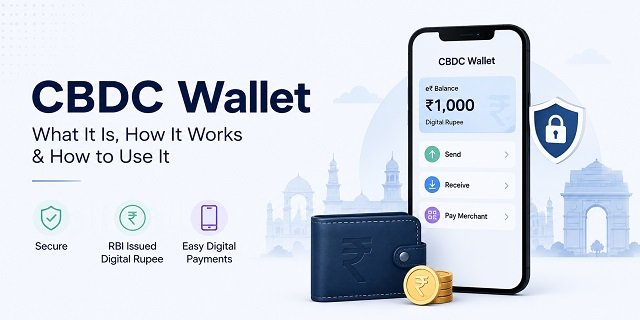
A CBDC Wallet is the official digital wallet used to store and transact Digital Rupee (e₹), India’s Central Bank Digital Currency (CBDC) issued by the Reserve Bank of India (RBI). Unlike private digital wallets or payment apps, every Digital Rupee held in a CBDC Wallet is a direct liability of the Reserve Bank of India, giving it the same value as physical cash.
The RBI introduced the retail Digital Rupee (e₹-R) to provide citizens with a secure digital form of sovereign currency that can be used for everyday payments. Users can pay merchants, transfer money to another CBDC Wallet, receive payments instantly, and make QR code transactions without carrying physical cash.
Many people confuse a CBDC Wallet with UPI, internet banking, or mobile wallets such as Paytm Wallet. Although all of them support digital payments, they work differently. A UPI payment transfers money between bank accounts, whereas a CBDC Wallet stores Digital Rupee issued directly by the RBI. This makes the Digital Rupee a digital equivalent of cash rather than a bank deposit.
As the Digital Rupee ecosystem expands, CBDC Wallets are expected to play an important role in person-to-person payments, merchant transactions, government benefit distribution, and future digital payment innovations. Understanding how a CBDC Wallet works today will help you use upcoming RBI digital currency services with greater confidence.
CBDC Wallet Highlights
| Particular | Details |
|---|---|
| Full Form | Central Bank Digital Currency Wallet |
| Stores | Retail Digital Rupee (e₹-R) |
| Issued By | Reserve Bank of India (RBI) |
| Currency Type | Digital form of sovereign Indian Rupee |
| Supported Transactions | Person-to-Person (P2P) and Person-to-Merchant (P2M) payments |
| Payment Method | QR code and wallet-to-wallet transfers |
| Availability | Through participating banks and authorised service providers under the RBI CBDC initiative |
| Main Purpose | Enable secure digital payments using RBI-issued Digital Rupee |
What is a CBDC Wallet?
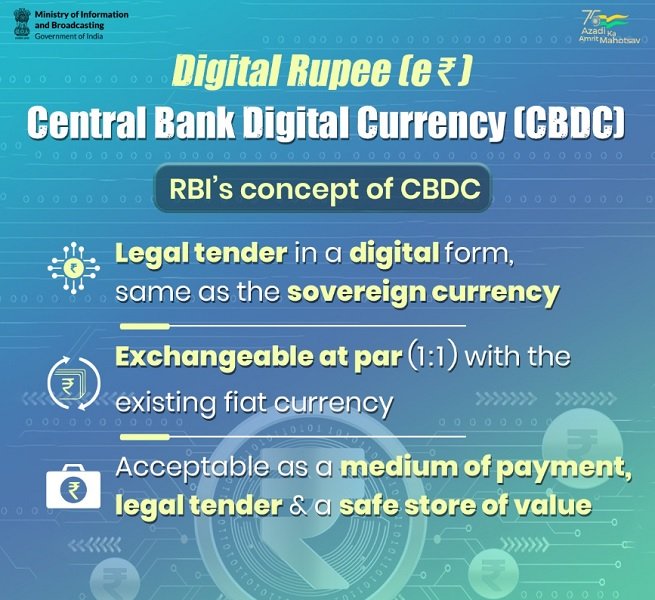
A CBDC Wallet is a digital wallet that allows users to hold, send, receive, and spend Digital Rupee (e₹). Instead of storing money issued by a commercial bank, the wallet stores Digital Rupee issued by the Reserve Bank of India, making it a digital representation of physical cash.
Every Digital Rupee in the wallet carries the same face value as the Indian Rupee. For example, one Digital Rupee (e₹1) has the same value as one physical rupee. You can use it for everyday purchases, transfer it to another eligible user, or pay merchants that accept CBDC payments.
The CBDC Wallet is designed to offer the convenience of digital payments while retaining the characteristics of sovereign currency. Since the Digital Rupee is issued by the RBI, users do not need to worry about currency conversion or fluctuating value. The amount stored in the wallet always remains equal to its face value.
How Does a CBDC Wallet Work?
A CBDC Wallet works by allowing you to store and use Digital Rupee (e₹) issued by the Reserve Bank of India (RBI). After activating the wallet through a participating bank or authorised service provider, you can load Digital Rupee into the wallet and use it for everyday payments without carrying physical cash.
Whenever you make a payment, the Digital Rupee moves directly from your CBDC Wallet to the recipient’s wallet or merchant’s wallet. The transaction is completed digitally while the value of the currency remains exactly the same as physical Indian Rupees.
The entire payment process happens within the RBI’s Digital Rupee ecosystem, ensuring that the currency being transferred is issued by the Reserve Bank of India rather than created by a commercial bank or a private payment company.
| Step | What Happens |
|---|---|
| 1 | You activate a CBDC Wallet through a participating bank or authorised provider. |
| 2 | You obtain Digital Rupee (e₹) in your wallet through the supported onboarding process. |
| 3 | You use the wallet to send money, receive payments, or pay merchants using supported payment methods. |
| 4 | The recipient instantly receives the Digital Rupee in their eligible wallet. |
How Does a CBDC Payment Move?
The movement of Digital Rupee is straightforward. Instead of transferring a bank deposit from one account to another, the system transfers Digital Rupee held inside eligible CBDC Wallets.
| Payment Stage | Transaction Flow |
|---|---|
| Wallet Funding | Digital Rupee becomes available in your CBDC Wallet through the supported process. |
| Payment Initiated | You enter the amount or scan a supported QR code. |
| Transaction Processing | The Digital Rupee is transferred electronically to the recipient. |
| Confirmation | Both parties receive confirmation after the transaction is completed. |
What Can You Do with a CBDC Wallet?
A CBDC Wallet is designed for day-to-day digital payments. Depending on the features made available by the participating bank or authorised provider, users can perform several common transactions using Digital Rupee.
- Send Digital Rupee to another eligible CBDC Wallet.
- Receive Digital Rupee from other users.
- Pay merchants by scanning supported QR codes.
- Make person-to-person (P2P) payments.
- Make person-to-merchant (P2M) payments.
- View wallet balance and transaction history.
- Use additional features introduced during RBI’s Digital Rupee rollout.
Key Features of a CBDC Wallet
| Feature | Description |
|---|---|
| Issued by RBI | The Digital Rupee stored in the wallet is issued by the Reserve Bank of India. |
| Same Value as Cash | Every Digital Rupee has the same value as the corresponding physical Indian Rupee. |
| Instant Digital Payments | Supports fast digital transfers between eligible users and merchants. |
| QR Code Payments | Enables payments by scanning supported QR codes. |
| Digital Convenience | Allows users to carry and use Digital Rupee without physical cash. |
| Government-backed Currency | The Digital Rupee is sovereign currency issued by the RBI. |
CBDC Wallet vs UPI: What Is the Difference?
Many people assume that a CBDC Wallet is another version of UPI. In reality, they serve different purposes. A UPI transaction moves money from one bank account to another, whereas a CBDC Wallet stores and transfers Digital Rupee (e₹) issued by the Reserve Bank of India (RBI).
Although both systems allow fast digital payments, the type of money being transferred is different. Understanding this distinction helps users choose the right payment method for different situations.
| CBDC Wallet | UPI |
|---|---|
| Stores Digital Rupee (e₹) issued by the RBI. | Transfers money between bank accounts. |
| Represents sovereign digital currency. | Acts as a payment system connecting bank accounts. |
| Requires a supported CBDC Wallet. | Requires a bank account linked to UPI. |
| Uses Digital Rupee available in the wallet. | Debits money directly from the linked bank account. |
| Designed specifically for the RBI’s Digital Rupee ecosystem. | Supports digital payments across participating banks and apps. |
CBDC Wallet vs Bank Account
A CBDC Wallet and a bank account both allow digital transactions, but they are not the same. Your savings account represents money deposited with a bank, while a CBDC Wallet holds Digital Rupee issued directly by the RBI.
| CBDC Wallet | Bank Account |
|---|---|
| Stores Digital Rupee (e₹). | Stores customer deposits maintained by a bank. |
| Issued under the RBI’s CBDC framework. | Operated by the respective commercial bank. |
| Mainly designed for Digital Rupee transactions. | Supports deposits, withdrawals, loans, interest, and other banking services. |
| Focuses on digital currency payments. | Provides a complete range of banking services. |
A CBDC Wallet is therefore not a replacement for your savings account. Instead, it provides another way to make digital payments using the Digital Rupee.
CBDC Wallet vs Mobile Wallet
Mobile wallets and CBDC Wallets may appear similar because both are used through smartphone applications. However, they operate differently and store different types of value.
| CBDC Wallet | Mobile Wallet |
|---|---|
| Stores RBI-issued Digital Rupee. | Stores wallet balance according to the service provider’s framework. |
| Uses sovereign digital currency. | Uses prepaid wallet value. |
| Designed specifically for Digital Rupee payments. | Supports payments through the wallet service. |
| Issued through participating banks and authorised providers. | Provided by the respective wallet company. |
Who Can Use a CBDC Wallet?
The RBI is expanding the Digital Rupee ecosystem in phases through participating banks and authorised service providers. Availability may therefore depend on the bank you use and the services currently offered in your area.
In general, a CBDC Wallet is intended for eligible individuals who complete the onboarding process through a participating institution. As the Digital Rupee ecosystem continues to expand, more users, merchants, and service providers are expected to gain access.
- Individual users eligible under the participating bank’s onboarding process.
- Merchants enabled to accept Digital Rupee payments.
- Businesses and institutions included in the RBI’s expanding CBDC ecosystem.
- Users approved by authorised service providers participating in the Digital Rupee initiative.
Which Banks Offer a CBDC Wallet?
The Reserve Bank of India (RBI) is introducing the Digital Rupee in phases through selected participating banks and authorised service providers. Instead of launching a single wallet for everyone, the RBI allows participating institutions to offer CBDC Wallet services to eligible customers through their own applications.
As the Digital Rupee ecosystem expands, the number of participating institutions may increase. Before downloading a wallet, check whether your bank currently supports the Digital Rupee service.
| Institution Type | Role in the CBDC Ecosystem |
|---|---|
| Participating Banks | Provide CBDC Wallet services, customer onboarding, and Digital Rupee transactions under the RBI framework. |
| Authorised Service Providers | Offer approved Digital Rupee services in partnership with participating banks wherever applicable. |
| Reserve Bank of India | Issues the Digital Rupee (e₹) and regulates the overall CBDC ecosystem. |
What Do You Need Before Opening a CBDC Wallet?
Opening a CBDC Wallet is a simple process, but you should keep a few essentials ready before starting the registration. Having these details available helps complete the onboarding process without unnecessary interruptions.
| Requirement | Purpose |
|---|---|
| Smartphone | Required to install and use the CBDC Wallet application. |
| Registered Mobile Number | Used for OTP verification and account authentication. |
| Bank Relationship (where applicable) | Some participating banks may require you to be an eligible customer before activating the wallet. |
| Identity Verification | May be required as part of the onboarding process, depending on the participating institution. |
| Internet Connection | Required for registration, verification, and most online wallet activities. |
The exact onboarding requirements may vary slightly between participating institutions because each bank provides the service through its own application while following the RBI’s Digital Rupee framework.
How to Open a CBDC Wallet
Although the interface may differ from one participating bank to another, the overall registration process follows a similar pattern.
Step 1: Download the official CBDC Wallet application provided by your participating bank or authorised service provider.
Step 2: Register using your mobile number and complete the required OTP verification.
Step 3: Complete the onboarding process by providing the information requested by the participating institution.
Step 4: If identity verification is required, follow the instructions displayed in the application and complete the necessary verification.
Step 5: Once your registration is approved, your CBDC Wallet becomes active and is ready to receive or use Digital Rupee according to the features supported by your institution.
How to Add Digital Rupee to Your CBDC Wallet
Before making payments, your wallet must contain Digital Rupee. Participating institutions provide supported methods for obtaining Digital Rupee and adding it to your CBDC Wallet.
Step 1: Open your CBDC Wallet application and sign in securely.
Step 2: Select the option provided for obtaining or loading Digital Rupee.
Step 3: Follow the instructions displayed by your participating institution to complete the transaction.
Step 4: After the transaction is successful, the Digital Rupee balance appears in your wallet and becomes available for payments.
How to Send Money Using a CBDC Wallet
Once your CBDC Wallet contains Digital Rupee (e₹), you can transfer funds to another eligible user through the payment options supported by your participating bank or authorised service provider. The transaction is completed digitally, and the recipient receives the Digital Rupee directly in their eligible CBDC Wallet.
Step 1: Open your CBDC Wallet application and sign in securely.
Step 2: Select the option to send or transfer Digital Rupee.
Step 3: Choose the recipient using the available payment method, such as a registered contact or the supported wallet identifier.
Step 4: Enter the amount you want to transfer and review the payment details carefully.
Step 5: Confirm the transaction using the authentication method supported by your wallet. Once the transaction is successful, both sender and recipient receive a confirmation.
How to Receive Money in a CBDC Wallet
Receiving Digital Rupee is as simple as receiving any other digital payment. The sender transfers the amount to your eligible CBDC Wallet using the supported payment method.
After the transaction is completed successfully, the received amount appears in your wallet balance almost immediately. You can then use the Digital Rupee for future payments or other supported transactions.
How to Pay Merchants Using a CBDC Wallet
Many participating merchants accept Digital Rupee payments through supported QR codes. Paying with a CBDC Wallet follows a familiar process, making it easy for users who already make digital payments.
Step 1: Open your CBDC Wallet and choose the QR payment option.
Step 2: Scan the merchant’s supported QR code.
Step 3: Verify the merchant details and enter the payment amount if it is not filled automatically.
Step 4: Review the transaction and confirm the payment.
Step 5: Once the payment is successful, both you and the merchant receive a confirmation through the application.
How to Check Your CBDC Wallet Balance
You can view your available Digital Rupee balance at any time by opening your CBDC Wallet application. Most participating wallet applications display the current balance on the home screen after you sign in.
In addition to the available balance, many applications also provide a transaction history showing recent payments, receipts, and other wallet activities.
Can You Convert Digital Rupee Back into Bank Money?
Participating institutions provide supported methods for converting Digital Rupee back into the linked banking system wherever this functionality is available. The exact process may differ between banks because each institution manages its own CBDC Wallet application within the RBI’s Digital Rupee framework.
To complete the conversion, open your CBDC Wallet and use the option provided by your participating institution. Follow the on-screen instructions to transfer the supported amount according to the features available in your wallet.
Is a CBDC Wallet Safe to Use?
Yes. A CBDC Wallet operates within the Digital Rupee framework introduced by the Reserve Bank of India (RBI). Since the wallet stores Digital Rupee (e₹) issued by the RBI, users can make digital payments using sovereign currency instead of relying on privately issued digital value.
Security features may differ slightly between participating institutions, but most CBDC Wallet applications include user authentication, secure login methods, and transaction confirmation before completing a payment.
Like any digital payment application, users should also follow basic security practices to protect their wallet and personal information.
- Keep your mobile phone protected with a screen lock.
- Never share your wallet PIN, password, or OTP with anyone.
- Download the CBDC Wallet only from official app stores or your bank’s official website.
- Install application updates whenever they are released.
- Verify the recipient’s details before confirming a payment.
What Should You Do If Your Phone Is Lost?
If the mobile phone linked to your CBDC Wallet is lost or stolen, act immediately to protect your wallet from unauthorised access.
Step 1: Contact your participating bank or authorised service provider using its official customer support channels.
Step 2: Request temporary blocking or suspension of your CBDC Wallet, if such a facility is available.
Step 3: Block your mobile SIM through your telecom service provider to prevent misuse of OTP-based verification.
Step 4: After obtaining a replacement device or SIM, follow your participating institution’s official wallet recovery process.
Can a CBDC Wallet Work Without the Internet?
The RBI has been testing offline functionality for the Digital Rupee as part of its ongoing CBDC initiatives. Offline capability is intended to support digital payments even in locations where internet connectivity is weak or temporarily unavailable.
However, the availability of offline payments depends on the features currently supported by the participating institution and the stage of the RBI’s rollout. Not every CBDC Wallet offers identical offline capabilities.
Before relying on offline payments, check whether your participating bank has enabled this feature for your wallet.
What Is Programmable CBDC?
Programmable CBDC is an evolving feature of the Digital Rupee ecosystem that allows Digital Rupee to be used for specific purposes under approved conditions. Instead of functioning as a general-purpose payment, the Digital Rupee can be programmed for a predefined objective wherever such functionality is introduced.
For example, a government authority or an organisation may issue a Digital Rupee that is intended for a specific use case, subject to the applicable rules and the features supported under the RBI’s CBDC framework.
This capability is being explored for selected pilot use cases and future digital payment innovations.
Are There Any Charges for Using a CBDC Wallet?
The charges applicable to a CBDC Wallet depend on the policies of the participating institution and the services being used. The RBI provides the Digital Rupee framework, while participating banks manage customer-facing wallet services.
Before completing any transaction, review the applicable terms displayed by your participating bank. If any fee applies to a particular service, it will generally be communicated through the official application or the bank’s published schedule of charges.
Are There Any Transaction Limits?
Transaction limits, wallet balance limits, and other operational restrictions are determined according to the RBI framework and the implementation adopted by the participating institution. These limits may change over time as the Digital Rupee ecosystem expands.
Always refer to your participating bank’s latest CBDC Wallet guidelines for the most up-to-date limits applicable to your account.
Common CBDC Wallet Problems and Their Solutions
| Problem | Possible Solution |
|---|---|
| OTP not received | Check your mobile network, verify the registered mobile number, and request a new OTP after waiting for a short time. |
| Unable to log in | Confirm that you are using the correct credentials and update the application if a newer version is available. |
| Payment failed | Check your internet connection, verify the payment details, and review your wallet balance before trying again. |
| QR code cannot be scanned | Improve lighting, clean the camera lens, or enter the payment details manually if supported. |
| Wallet not working after changing the phone | Follow the official wallet activation or recovery process provided by your participating bank. |
| Transaction status is pending | Wait for the final confirmation and contact your participating institution if the status does not update within the expected time. |
What Is the Future of CBDC Wallets in India?
The Reserve Bank of India (RBI) continues to expand the Digital Rupee ecosystem through a phased approach. As more participating banks, merchants, and users join the initiative, CBDC Wallets are expected to become available to a wider section of the population.
The RBI is also exploring new capabilities such as offline payments, programmable Digital Rupee, and additional payment use cases. These developments are intended to make digital payments more accessible while supporting innovation in India’s payment ecosystem.
As the Digital Rupee evolves, CBDC Wallets may be used in more everyday transactions, government payment programmes, business settlements, and other approved financial services. The exact features available to users will continue to depend on future RBI guidelines and the services introduced by participating institutions.
Quick Reference
| Particular | Details |
|---|---|
| Wallet Name | CBDC Wallet |
| Stores | Digital Rupee (e₹) |
| Issued By | Reserve Bank of India (RBI) |
| Currency Type | Central Bank Digital Currency (CBDC) |
| Supported Payments | Person-to-Person (P2P) and Person-to-Merchant (P2M) |
| Payment Methods | Wallet transfer and supported QR code payments |
| Available Through | Participating banks and authorised service providers |
| Works With | Eligible CBDC Wallet users and participating merchants |
| Offline Capability | Available only where supported under the RBI rollout. |
| Programmable CBDC | Introduced for approved use cases under the RBI framework. |
| Official Regulator | Reserve Bank of India |
Frequently Asked Questions
Q. What is a CBDC Wallet?
Ans. A CBDC Wallet is a digital wallet used to store and transact Digital Rupee (e₹), India’s Central Bank Digital Currency issued by the Reserve Bank of India (RBI).
Q. Is a CBDC Wallet the same as UPI?
Ans. No. A UPI transaction transfers money between bank accounts, whereas a CBDC Wallet stores and transfers Digital Rupee issued by the RBI.
Q. Can I use a CBDC Wallet without a bank account?
Ans. The onboarding process depends on the participating bank or authorised service provider. Check your institution’s eligibility requirements before registering.
Q. Does the Digital Rupee have the same value as physical cash?
Ans. Yes. Every Digital Rupee carries the same face value as the corresponding physical Indian Rupee.
Q. Can I pay by scanning a QR code?
Ans. Yes. Supported CBDC Wallets allow users to make payments by scanning eligible QR codes accepted by participating merchants.
Q. Is a CBDC Wallet safe?
Ans. CBDC Wallets operate within the RBI’s Digital Rupee framework. Users should also follow good security practices, such as protecting their device and never sharing OTPs or wallet credentials.
Q. What happens if I lose my phone?
Ans. Contact your participating bank immediately, request wallet protection if available, block your SIM card, and follow the official wallet recovery process provided by your institution.
Q. Can I use a CBDC Wallet without an internet connection?
Ans. Offline functionality is being introduced in phases. Availability depends on the participating institution and the features currently supported under the RBI’s rollout.
Q. Can I convert Digital Rupee back through my participating institution?
Ans. Yes, where supported. The exact process depends on the participating bank or authorised service provider offering the CBDC Wallet.
Q. Which authority regulates CBDC Wallets in India?
Ans. The Reserve Bank of India (RBI) issues the Digital Rupee and regulates the overall Central Bank Digital Currency framework in India.
Q. Are there any charges for using a CBDC Wallet?
Ans. Charges, if applicable, depend on the participating institution and the specific service being used. Always check your bank’s latest terms before completing a transaction.
Q. Can businesses also accept Digital Rupee payments?
Ans. Yes. Participating merchants enabled under the RBI’s Digital Rupee ecosystem can accept payments through supported CBDC Wallets.

Tabassum is a government document researcher and writer with over 5 years of experience exclusively dedicated to tracking and simplifying Central and State Government document processes across India. She has researched and published detailed guides on 100+ government documents and certificates – including Aadhaar Card, PAN Card, Ration Card, Domicile Certificate, and Birth Certificate – covering all states and the Central Government, helping lakhs of Indian citizens successfully complete their paperwork in simple, easy-to-understand language.